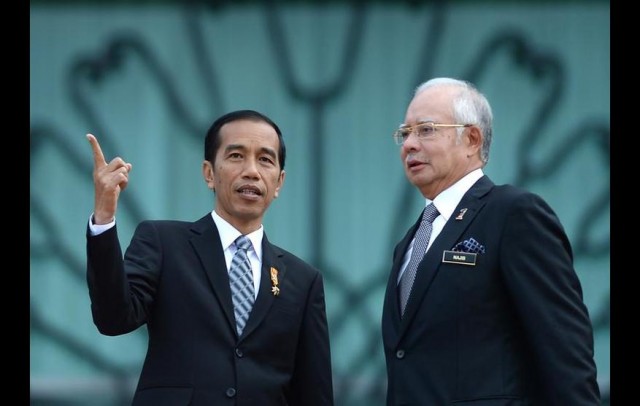
JAKARTA: The President of Indonesia and the Prime Minister of Malaysia agreed to peacefully resolve future maritime disputes and to encourage and protect investors from each other’s country here the other day.
This is Indonesian President Joko Widodo’s first state visit abroad since taking office in October 2014. Relations between the two neighboring Southeast Asian nations had been slightly strained by Indonesia’s controversial crackdown on illegal fishing in its waters in recent months. Malaysian, Vietnamese, Filipino, Thai, and Chinese boats caught illegally fishing have been seized and blown up, signaling that the days of lax enforcement are over.

Illegal fishing is estimated to cost Indonesia some $23.3 billion per year, and Indonesia’s president (known universally as Jokowi) said that around 5,000 ships, mostly foreign, illegally fish in Indonesia’s coastal waters every day. In December alone, shortly after Jokowi’s announcement of the new “shock therapy” sinking policy, over 150 foreign ships were seized. The Indonesian navy first arrests and deports crew members of the seized vessels before sinking them. The hardline policy is working, and while illegal fishermen do not report statistics, anecdotal evidence suggests that foreign fishing boats are scaling back their operations in Indonesian waters.
Friday’s agreement stipulates that if a Malaysian vessel has trespassed Indonesian territory, it will face legal action, and likewise for Indonesian vessels in Malaysian territory. For areas of overlapping, disputed claims (for which the Malaysia-Indonesia boundary technical committee has met 26 times but still not made significant progress), both countries agreed that maritime authorities will send vessels back to their respective waters.
Closer ties between Malaysia and Indonesia go beyond improved cooperation on fishing. Overall bilateral trade was $18.25 billion in 2014, short of the $30 billion target, but other initiatives were announced that will promote future trade and investments. First is a proposal for the Association of Southeast Asian Nations (ASEAN), a ten-member trading bloc, to adopt a single time zone. Malaysian P.M. Najib Razak said on Friday that doing so would improve bilateral trade with Indonesia, show ASEAN solidarity, and ease the integration of capital markets and business management between the member states. Jokowi agreed to seriously discuss the issue, although the other ASEAN nations will have to come to a consensus as well, which has eluded them in earlier attempts.
The second initiative is that Malaysia’s national carmaker Proton signed an agreement on Friday with PT Adiperkasa, a private Indonesian firm backed by the government, to study the development of a national Indonesian car. If the six-month study provides feasible results, then there will be joint production in the new Indonesian auto industry, which has great potential. Proton has seen its sales plunge in Malaysia and abroad, but Indonesia’s population of 250 million could be a lifeline for it, as auto sales there topped 1 million vehicles in 2014 and could reach 4 million. Tariff protections would be enacted, guaranteeing Proton a major market advantage over foreign competitors selling in Indonesia.
According to A.P., Proton’s chairman Mahathir Mohamad (a former P.M. of Malaysia) said that the company would have to invest in the Indonesian project and may not make money at first, but it would benefit once the car is accepted and sales pick up in Indonesia. Showing how intertwined business and politics are, he added that”we would like to make use of the joint venture with Indonesia to expand and become an ASEAN car,” which would entail future investment and political backing from fellow member states.