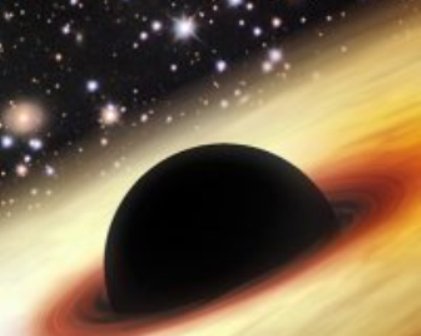


FRANCE: The prevailing view in astrophysics has been that black holes do not release any information about what formed them or objects that have fallen into them. This idea was advanced by Stephen Hawking in the 1970s; Hawking postulated that black holes emitted particles and simultaneously lost energy, eventually shrinking away to nothing. Hawking’s hypothesis posited that those particles could not provide information on the interior of the black hole.
This hypothesis violated the conservation of information, part of quantum mechanics. This problem, dubbed the information loss paradox, has been ameliorated with Hawking’s rejection of his hypothesis, stating that black holes could give up information, thought the process necessary to preserve and emit information from a black hole has been mysterious.
Now, a new study by Dejan Stojkovic and Anshui Saini of the University of Buffalo, indicates that information can escape from a black hole in the form of interactions among emitted particles. According to a UB statement, the new research examined not only the particles themselves, but also the range of “correlations” that can take place, such as gravitational attraction and the exchange of photons. The new analysis demonstrated that information on the attributes of the object that created the black hole itself and the matter and energy pulled into the black hole can be ascertained.
“These correlations were often ignored in related calculations since they were thought to be small and not capable of making a significant difference,” Stojkovic said. “Our explicit calculations show that though the correlations start off very small, they grow in time and become large enough to change the outcome.”

Pakistan to get $3b loan from Islamic Trade Financing Corporation
ISLAMABAD: Islamic Trade Financing Corporation (ITFC) to provide Pakistan with a $3 billion loan, according to an official statement released...