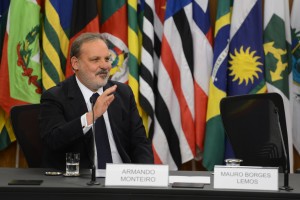
SÃO PAULO: During the next four years Brazil will work toward strengthening its commercial ties with the United States, expanding its accords with Mercosur partners as well as finalizing trade agreements with Central and South American countries such as Mexico, Peru, Colombia and Chile, stated the new Development, Industry and Foreign Trade (MDIC) Minister, Armando Monteiro Neto, during his first speech as minister here the other day.
“Governments must respond to the demands and circumstances of a given moment. We have to adjust our focus and strategy and enter other trade agreements, such as with those countries of the Pacific Basin, and enhance our partnership with the United States, which is recovering economically and will once again drive international trade,” said Monteiro.

In addition, the new minister noted that despite the economic difficulties faced by some Mercosur partners (composed of Brazil, Argentina, Uruguay, Paraguay and Venezuela), the challenge for this administration will be to consolidate the economic trading bloc.
“Mercosur is a complex construction with asymmetries within the bloc. The challenge is to construct a customs union within the reality that each country has a different economic policy.”
Monteiro stressed that the current goal of the bloc is to return to the negotiations table for an agreement between Mercosur and the European Union. “All the countries in the bloc have already reached a common denominator to present a proposal to the European Union,” he explained. The next set of talks is scheduled for March.
As for the country’s trade balance, Monteiro stated to be optimistic in relation to 2015 exports, especially in terms of agricultural products being sold abroad. “We will have a larger harvest. The volume of exports should grow, compensating the loss of revenues due to (lower) prices.”
Ministry of Development, Industry and Foreign Trade wants to increase exports from ports such as this in Manaus, Amazonas photo by H. Langos/Wikimedia Creative Commons License.
According to the official, in addition to the recovery of the U.S. economy and a record harvest expected this year, petroleum production should register an increase and help the country’s trade balance. Estimates are that the deficit in the petroleum account, which was of US$ 16 billion in 2014, will continue to decline in 2015.
To try to lessen the effects of declining commodities prices in the international and domestic markets, Monteiro announced that the government will be publishing a plan to stimulate exports in the coming days. “Currently approximately one hundred companies are responsible for two-thirds of Brazilian exports. We need to find a new way to stimulate foreign sales by micro, small and medium sized companies,” he said.
Monteiro added that the new plan should include tax exemptions for exports, financing stimulus, and investments to make Brazilian companies more competitive abroad. The MDIC’s final trade balance for 2014 shows a deficit of US$3.93 billion, the worst result for the country since 1998.
In terms of industrial productivity, which has been declining in the past few years, Monteiro said he hopes his team will be able to reverse the tendency. “Industrial competitiveness is crucial. The sector has been losing space in the economy. Since 1985 [industry] participation declined from 25 percent to fourteen percent of the GDP.”
He added that he hoped the reduction in public spending announced by his colleagues in the Finance and Planning Ministries would not affect trade policies and incentives to the industry. “It is necessary that the macroeconomic adjustment not have a paralyzing effect on the competitiveness agenda. We must find a way, within these restrictions, to boost the [industry/trade] agenda,” he concluded.