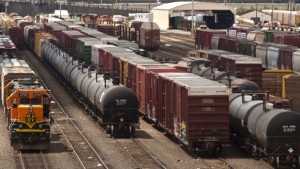
NEW YORK: Canadian and U.S. regulators will require railways to transition to tougher tank cars and bring in new braking systems for trains carrying flammable liquids, long-awaited steps aimed at reducing the frequency of fiery crude oil train derailments in North America.
The regulations announced on Friday set a 10-year schedule for railways operating in both countries to phase in the use of stronger, more crash-resistant tank cars for crude oil and other flammable liquids. The industry will also have to transition to new braking systems for trains carrying flammable liquids over a multi-year period, a step the railway industry has opposed.


During a press conference, U.S. Secretary of Transportation Anthony Foxx tied the new rules to the “staggering” growth in the amount of crude oil that is being transported by rail throughout North America. That growth can largely be attributed to increased production from shale deposits in Texas and North Dakota, he said.
Crude produced from North American shale deposits is widely believed to be more flammable than traditional oil and has been involved in numerous explosive derailments in Canada and the U.S., including a devastating accident in Lac-Mégantic, Que., nearly two years ago. The July 2013 accident occurred when a crude oil train came loose from its brakes and slammed into the centre of the small Quebec town, killing 47 people.
“We can never undo the damage that took place in Lac-Mégantic or in any other railway accident,” Ms. Raitt said. “But we can and we must learn from those events and improve our system.”
Ottawa and Washington have issued a patchwork of new regulations since the Lac-Mégantic disaster, covering speed limits, emergency planning and other issues. However, safety experts have long called for a more co-ordinated approach.
The Canadian government had previously proposed a 10-year phase-in period for the new tank cars, but regulators in the United States did not announce their plans until Friday. While the final timetable for eliminating older models of tank cars differs slightly between Canada and the U.S., both will require an eventual transition to “next-generation” tank car standards for all flammable liquids by May 1, 2025.
Safety experts have criticized the 10-year time frame, saying it will leave weaker cars on the rails for too long. Several explosive derailments in Canada and the U.S. in recent months involved an updated model of CPC-1232 tank cars that can be used for crude oil and other dangerous goods for another five years, according to the standards announced on Friday.
Tank car suppliers say it would be unreasonable to transition to the newest tank car model — which will require thicker steel, thermal protection and full shields at each end of the car — in less than 10 years.
The U.S. introduced new braking rules that will require trains carrying highly dangerous flammable goods to be equipped with electronically controlled pneumatic brakes by May 2023 if they are travelling at more than 30 miles per hour. Transport Canada did not include the braking rules in a set of regulations published on Friday, but Ms. Raitt said she has asked Canadian officials to harmonize Canadian braking rules with those announced by the U.S. on Friday.
“ECP brakes can reduce how long it takes a train to stop,” Mr. Foxx said on Friday. “They can prevent cars from slamming into each other, they can decrease the number of cars that derail, they can greatly reduce the probably the tank cars will puncture.”
While safety experts have advocated for ECP brakes, railways and rail car manufacturers oppose the idea, saying it is costly and does not do enough to improve safety. One industry expert put the cost of installing ECP brakes at about $8,000 per tank car.
The Association of American Railroads called the new U.S. braking rule “misguided” and said it would threaten rail capacity and service. “This is an imprudent decision made without supporting data or analysis,” AAR president Edward Hamberger said in a statement. “I have a hard time believing the determination to impose ECP brakes is anything but a rash rush to judgment.”