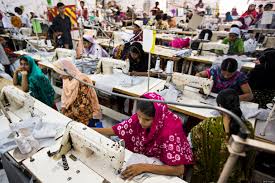
OTTAWA: Canada will be a key garment export destination for Bangladesh in achieving the $50 billion overseas sales target by the end of 2021, Canadian High Commissioner Benoît-Pierre Laramée said yesterday.
Currently, Bangladesh is the second largest garment exporting nation after China with shipments of $24.5 billion in the last fiscal year.


“Canada has been providing support to Bangladesh to develop workers’ skills and improve working conditions in the sector for higher export of garment items,” Laramee told a group of journalists at the first RMG Meet Up, a regular discussion by the Canada Bangladesh Chamber of Commerce and Industry (CanCham) with leading North American retailers and garment exporters at Westin Hotel in Dhaka.
Riding on duty-free benefits to Bangladesh since January 2003, garment exports to Canada have been on the rise in the last decade. Of Bangladesh’s exports to Canada, 96 percent are apparel items.
Between July and March, Bangladesh exported goods worth $734.02 million to Canada; it imported goods worth $495.80 million in July-February of the same fiscal year, according to data from the Export Promotion Bureau.
In fiscal 2013-14, Bangladesh’s exports to Canada were worth $1.1 billion, while imports were $585.5 million.
“A lot of progress in terms of inspection, progress in terms of remediation and transparency has been made in the garment sector after the Rana Plaza building collapse. We see major progress, but the momentum should be maintained,” Laramee said.
Bangladesh needs to take ownership of safety measure after the departure of the Accord and Alliance, the two foreign garment factory inspection agencies in the country.
After the industrial disasters — Tazreen Fashions fire and Rana Plaza collapse — the Accord and Alliance began factory inspections to develop structural, fire and electrical safety in Bangladesh in 2013.
The agencies completed their preliminary inspections in September and will wrap up their activities after five years of operations.
Atiqul Islam, president of Bangladesh Garment Manufacturers and Exporters Association, said the garment makers have been facing the challenges of poor infrastructure, political crisis, lower worker productivity and a lack of experience of mid-level management.
“An inadequate supply of gas and a ban on new gas connections to the factories are the biggest challenges for the garment sector now,” Islam added.
The rising cost of production and politicisation of trade unions are other major challenges for the sector, he said. “We are still confident that we will achieve the apparel export target of $50 billion by 2021.”
CanCham President Masud Rahman said the chamber has started its new initiative to hold quarterly discussions on ‘Journey to the Next Milestone: Strategy for the RMG Sector’ as garment exports to Canada are on the rise.
“The multi-billion dollar garment industry is currently passing through an interesting time. The overall performance of apparel exports in the last year compared to previous years has not been that different.”
“The growth rate has been around 9 percent over the previous year, which is slightly lower than the past five years’ average of around 12 percent,” he said.
Rahman said Bangladesh exported garment products worth $5.4 billion in 2013 to the US — the single largest export destination for the country — which is 9 percent higher than in 2012 and 158 percent higher than in 2003.