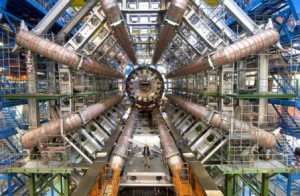

PARIS: The Large Hadron Collider (LHC), the world’s largest and most powerful particle collider, will resume operations for its second three-year run this month amid hopes of uncovering the universe’s best kept secrets.
The LHC, credited with uncovering the Higgs Boson particle and managed by the European Organisation for Nuclear Research (CERN), was on a two-year break from smashing particles to undergo an upgrade and will now operate with higher energy.
The machine is operated by CERN, a European research organisation that operates the largest particle physics laboratory in the world.
Having finally nailed down the elusive Higgs Boson particle in 2013 — the elementary particle that has unlocked some of the universe’s longest-standing secrets — physicists are now on the trail of dark matter.
Dark matter, which is still a hypothesis, will be one of the focus of the experiments.
“We are entering a new phase after two years of heavy maintenance and improvement of the infrastructure and to restart the LHC (Large Hadron Collider) now with higher energy opens new windows depending on the kindness of nature, of course. We are excited,” said Rolf Heuer, CERN Director-General.
Frederick Bordry, the Director for Accelerators and Technology, said, “We are turning into a new energy regime.
CERN expects the LHC to open in another two weeks where the protons will start circulating in the LHC. Then it will take some time. We have learnt to be patient.”
The LHC — which requires maintenance every three years — has been refurbished with new magnets, stronger connections, higher energy beams and superior cryogenics.
CERN expects to take till the end of May to reach collisions at the highest energy levels at 13 TEV — the highest ever for the LHC.
The first phase only saw energy levels reaching up to eight TEV, powerful beams which can melt a tonne of copper.

Tesla driverless system to use updated radar technology
WASHINGTON: Electric carmaker Tesla announced Sunday it was upgrading its Autopilot software to use more advanced radar technology. In a...