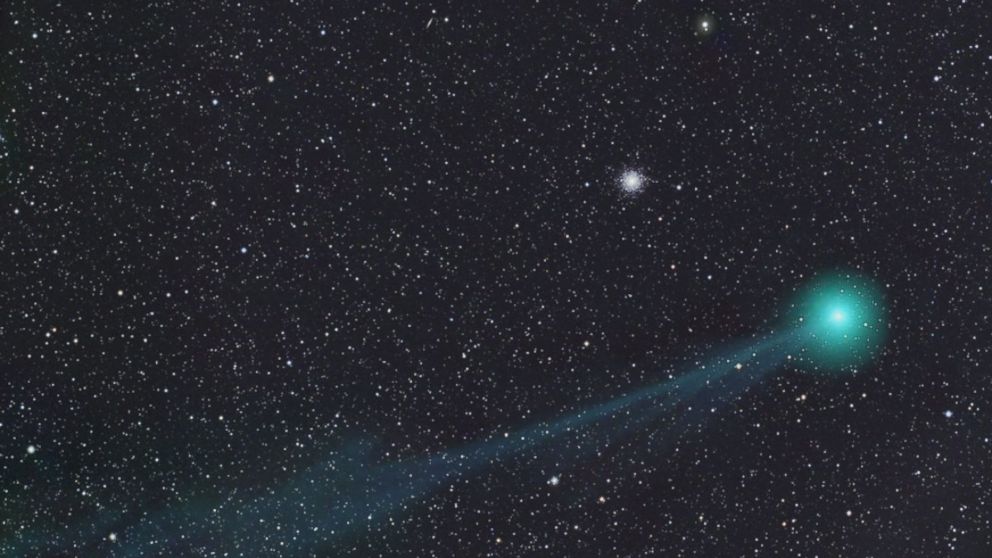
NEW YORK: Sky viewers should be able to get an excellent vision of the comet Lovejoy, or C/2014 Q2, which should be visible to the unaided eye under good circumstances for the next 10 days.
“Should we get a clear sky, comet Lovejoy should appear to the right side of the constellations Orion and Taurus, now visible in the southern sky,” said Bruce Palmquist, physics and science education professor at Central Washington University.
Palmquist also blogs about celestial matters on at “What’s Up in the Ellensburg Washington Sky” online at theellensburgsky.blogspot.com and for the Daily Record.
To see the comet, viewers should face due south, and look to the three stars that make up Orion’s belt.
“The comet should appear a little to the right of Orion’s belt or the snout of Taurus the bull,” he said. “With binoculars or a small telescope, you should be able to see it clearly. It will look sort of fuzzy, like a cotton ball.”
The comet head has a vivid green color, due to carbon molecules fluorescing in the sun’s ultraviolet light.
“The best time to see the comet should be after 8 p.m.,” he continued. “And it’s best to find a place away from any city lights — easy to do in our area.”
The comet was discovered by Australian amateur astronomer Terry Lovejoy in August 2014 and was his fifth comet discovery. It passed closest to Earth — 44 million miles — on Jan. 7.
The comet is known as a very long-period comet, with an orbital period of 11,500 years. The next time it will be visible to anyone on Earth will be roughly 10,000 years from now.