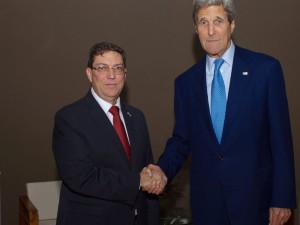
HAVANA: In a joint press conference with Cuban Foreign Minister Bruno Rodriguez, Secretary Kerry said it was a day for “removing barriers”. It is something that two countries do together when the citizens of both will benefit. “I just don’t see that”, he said.
The US flag was raised over the American embassy in Havana, Cuba, for the first time in 54 years. These dissidents are opposed to the one-party political system of Cuba. In 2002, former President Jimmy Carter addressed Cubans in an unprecedented hour of live, uncensored television – telling them their country did not meet global standards of democracy and repeatedly promoting a grass-roots campaign for greater civil liberties. With the prospect of change lifting the hearts of Cubans, many expected their government to tighten its repressive grip so that people don’t get carried away with what might be.
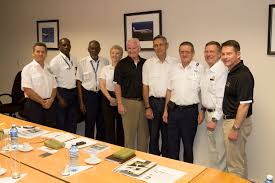

Kerry saluted marines James Tracy, Larry Morris and Mike East as the now elderly men handed the folded flag to three younger marines who raised it in a ceremony under the Caribbean Sunday.
Now that the United States and Cuba have restored diplomatic ties, what does it mean for other Latin American countries?
A year after the American flag was lowered in Cuba, in 1962 at age 26 Maria Vesa fled her home country for the United States. But dissidents were not invited to the flag-raising in deference to the Cuban government.
Like Obama, Kerry said the longtime U.S. strategy of trying to isolate Cuba and provoke regime change by choking off trade and fomenting grass-roots agitation had failed. They and the crowd who gathered on that January 4, 1961, day, were somber – unsure of when, or if, they would ever see the stars and stripes fly outside the embassy again.
Some 90 dissidents were arrested Sunday at a protest against the reopening of the US embassy in Havana.
Critics of Obama’s move, which seeks to end decades of US isolation and was announced last December in a landmark agreement with Cuban President Raul Castro, complain the Cuban government has made no concessions in exchange for diplomatic ties.
In addition to an official U.S. delegation, Kerry brought a plane full of Cuban-Americans and several pro-normalization lawmakers, including Sen.
Rodriguez stressed the two governments have distinct positions on various issues, including national sovereignty, democracy, human rights and the interpretation of historical events.
Mr Kerry said the US administration wanted to lift the trade embargo on the island – something that the Republican-controlled US Congress has blocked.