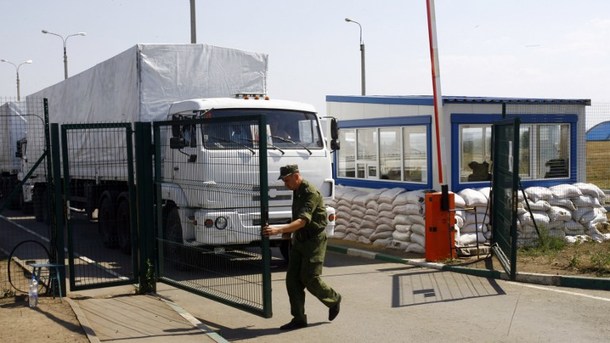
MOSCOW: Kazakh financial analyst Olzhas Khudaibergnov, Director at Center for Macroeconomic Research, said that the troubled situation in Russia was “pushing Kazakhstan to reintroduce customs checkpoints at the Russian border”. The customs border was removed when Russia, Kazakhstan and Belarus formed an economic alliance – the Customs Union – in 2010.
After the conflict in Ukraine started, Russia was hit by political and economic sanctions. Capital flight from the post-soviet country doubled. The decline in the global oil prices deprived the country of tens of billions of dollars in revenues. And on top of all this, by the end of 2014 the ruble began its dramatic fall exacerbated by the unexpected introduction of a free-floating regime in Russia. The devaluation made around 80% compared to the dollar-ruble exchange rate of mid-2014.


Russia is Kazakhstan’s top trade partner and co-member in the Eurasian Economic Union, an economic successor of the Customs Union. They share a huge common border of 6,846 kilometres and their mutual trade made $23.5 billion in 2013. Trade with Russia constitutes 36% of Kazakhstan’s overall trade turnover. The geographic and economic closeness of the two countries has resulted in the worsening of economic situation in Kazakhstan amid the problems experienced by Russia.
There have been losses in all the areas of trade with Russia. Due to the exchange rate differences, there is a substantial difference in prices of similar goods in Russia and Kazakhstan. There are streams of people from Kazakhstan traveling to Russia to buy cheaper products disrupting the official channels of imports.
The problem also works the other way around. There has been a sharp drop in Kazakh exports to Russia, after Russian goods suddenly became 80% cheaper rendering the Kazakh ones noncompetitive. The rising prices in Russia driven by the inflation rate of nearly 20% is gradually closing the gap, but the inflation rate is still far behind the rate of the devaluation.
For example, Kazakhstanis bought about 40,000 cars from Russia in November and December of 2014. This is 20,000 cars per month whereas the normal average made 6,000-7,000 cars per month. This practically nullified the demand for cars and sale by official dealers in Kazakhstan are expected to be close to zero in the first half of 2015.
Khudaibergenov said that the problems caused by the sliding ruble and cheap Russian goods could be resolved, but not through a landslide devaluation of the tenge – Kazakhstan’s currency – that many had been offering as a countermeasure.
Simply devaluing the Kazakh currency will not help, he said. “80% devaluation would make both the real sector of Kazakhstan’s economy go bankrupt, because it holds foreign currency-denominated loans totally worth $16.9 billion, and the population become broke because non-tenge household loans are worth $2.5 billion,” Khudaibergenov explained.
“Affecting an 80% devaluation would actually mean pegging the tenge to the ruble, which is a faulty decision if only because the ruble has broken old patterns and the like hood of it continuing to slide is high. Whereas a devaluation of 20% could solve the problem with the ruble,” he said, adding that the latter would nevertheless create an unwanted pattern in Kazakhstan – “a pattern of annual devaluation” – since there was a nearly 20% devaluation of the tenge in February 2014 in Kazakhstan.
The Kazakh expert suggested reintroducing customs checkpoints and customs duties together with them to protect the domestic market instead. Since 2010, Kazakhstan has been a member of the Customs Union, which has now morphed into the Eurasian Economic Union. Therefore, the country does not have effective mechanisms like custom duties to defend itself at the moment, save for exceptional cases.