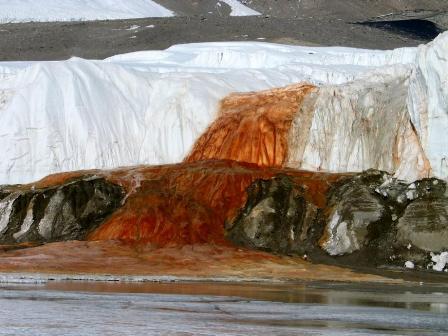


PARIS: At Blood Falls, deep red iron-rich water oozes out of a glacier. It’s dramatic and unmissable on its own, but Blood Falls has always hinted at some greater hidden thing—that would be a vast subterranean network of briny waters, which scientists have just started to map.
The salty water are likely the remnants of an ancient sea that still host microbial life. In a study published in Nature Communications today, scientists flew an electronmagnetic sensor over Taylor Valley in Antarctica. Based on the sensor’s readings, they could tell whether it was ice, soil, or something else entirely—likely liquid brine. “These inferred brines are widespread within permafrost and extend below glaciers and lakes,” they write.
The flights were conducted over the Antarctic austral summer in 2011. More recently, microbiologist Jill Mikucki, who helped carry out this electromagnetic research, led a team to actually sample the subterranean liquid brine. You can read about that expedition below. Those results aren’t published yet, but we’ll be waiting for them eagerly.

Pakistan to get $3b loan from Islamic Trade Financing Corporation
ISLAMABAD: Islamic Trade Financing Corporation (ITFC) to provide Pakistan with a $3 billion loan, according to an official statement released...