WASHINGTON: According to research the early Rosetta results reveal that comets are much more complicated than anyone knew.
In a flurry of seven papers published Thursday in the journal Science, researchers provide the first data-driven snapshot of comet 67P/Churyumov-Gerasimenko – a world of towering cliffs, wide flat basins, powdery surfaces blacker than coal, and a growing atmosphere that will soon be strong enough to deflect the solar wind.


A handful of other spacecraft have flown past comets, but Rosetta is the first one to travel alongside a comet as it makes its way to perihelion in August – the moment when it will be closest to the sun.
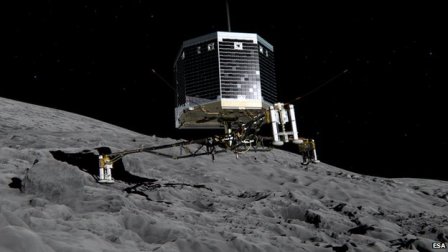
Most of the data referenced in the Science studies were collected between April and September, when Rosetta was still sailing toward the comet, and months before Philae’s nail-biting landing on its surface.
“What these papers are talking about is a place where we don’t have a lot of previous observations of comets,” said Paul Weissman of the Jet Propulsion Laboratory and an interdisciplinary scientist on the mission. “We are exploring unknown territory.”
Each of the Science papers describes a different aspect of the comet, including observations of the size and density of the dust in its coma, the composition of the organic material on its surface, where the gas jets seem to spring from its nucleus, and its mesmerizing geology.
So far, scientists have found no evidence of water on the comet’s surface, suggesting that the comet’s remaining water is insulated from the sun’s warmth by the comet’s dusty coat.
Another paper notes that jets of gas streaming off the comet are coming primarily from the neck region.
Researchers have also identified 19 distinct geographical areas that have been named for Egyptian deities such as Ma’at, Imhotep, Aten and Ash.