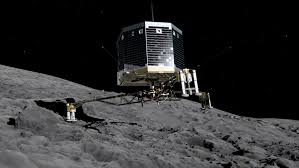
NEW YORK: Scientists have been searching for Philae lander ever since the robotic probe lost power after landing on Comet 67P in November 2014.
To find the final landing place of the Philae lander, researchers have been looking at the images sent to Earth by the European Space Agency’s Rosetta spacecraft as well as variety of data, which include magnetic field and radio wave measurement.


Now the efforts of the researchers have helped them narrow down the probable area of landing the Philae to just one part of the comet.
It is now believed that Philae landed in a shady area where there is not enough of light to fully charge the spacecraft causing the lander to shut down after 60 hours on the comets surface.
Based on the radio signals sent between the lander and Rosette, ESA reported that the Philae could be in the ellipse about 16×160 meters long and wide just outside the rim of a large depression on the comet’s head known as Hatmehit.
ESA said, “Combining data on the signal travel time between the two spacecraft with the known trajectory of Rosetta and the current best shape model for the comet, the CONSERT team have been able to establish the location of Philae to within an ellipse roughly 16 x 160 metres in size, just outside the rim of the Hatmehit depression.”
ESA also said that while the ellipse is currently the best estimate of the probable location of the lander based on a number of simulations, work is still ongoing to quantify the statistical likelihood of the probe inside this region.