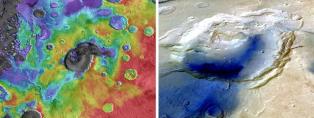

LONDON: The European Space Agency has found what it believes to be a supervolcano on the surface of Mars that could be the Red Planet’s equivalent of Yellowstone. The massive crater has been measured to be 40 kilometers by 30 kilometers and drops as low as 1,750 meters.
The exterior of Mars is full of holes and craters. One of these, however, stands out among the rest. The Siloe Patera crater, which is located in the Arabia Terra region of the planet, actually consists of two large craters that overlap one another and covers a total area of 120 square kilometers.
Images of the crater were captures using the high resolution stereo camera aboard the European Space Agency’s Mars Express craft on November 26, 2014.
Supervolcanoes are simply large volcanoes that can produce at least 1,000 cubic kilometers of volcanic material during an eruption. For example, scientists recently discovered a new magma chamber in Yellowstone here on Earth that contains anywhere between 30,000 and 116,000 cubic kilometers of volcanic material. That is enough material to fill the Grand Canyon 11 times.
Scientists studying the Siloe Patera crater on Mars believe that the crater is actually a caldera, the collapsed center of a volcano. Unlike regular volcanoes, supervolcanoes do not have a cone shape because the enormity of the explosion triggered by the pressure of the magma and the speed in which it happens.
That means that finding a supervolcano that erupted millions, or even billions of years ago is not always easy.

Tesla driverless system to use updated radar technology
WASHINGTON: Electric carmaker Tesla announced Sunday it was upgrading its Autopilot software to use more advanced radar technology. In a...