KENYA: A German member of European Parliament criticized EU agreements saying that markets of developed countries are bound to sign deals with EU, for they won’t be granted access if they don’t do so. Because EU imposed tariffs on Kenya’s cut flowers making them more expensive and thus creating a blow to their supply.
“Developing countries have a gun pointed at their chest – either they sign or their market access to the EU is restricted,” says Ska Keller, a German member of the European Parliament who is appalled at the way the European Union brokered a trade agreement with east Africa late last year.


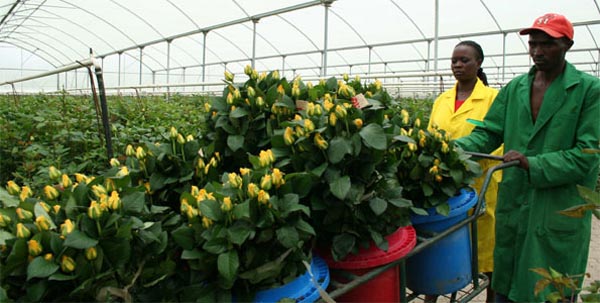
In this case the gun was pointed at Kenya – more specifically, its cut flowers industry. The flower business is a lucrative one, worth more than €10bn (£7.7bn) worldwide every year and Kenya is one of the world’s largest exporters of cut stems. So it was a crushing blow when Europe imposed tariffs on Kenya’s cut flowers in October last year, potentially making their blooms significantly more expensive than those grown on European soil. Rather than risk losing trade to other suppliers, Kenyan flower companies absorbed the duties. In the three months they were in place, the Kenya Flower Council estimates that its exporters racked up costs of about €3m (£2.3m).
Kenya was being punished for failing to sign a new trade agreement. As the cut flower industry started to feel the pain, Nairobi snapped and signed on the dotted line. The EU removed the duties on Christmas Day, meaning Kenya’s flower exporters have a clean run up to Valentine’s Day. Lodewijk Briet, the EU’s ambassador to Kenya, said in a statement that the EU had “fast-tracked” approval of the deal and called it a “Christmas gift for Kenyan exporters”.
While the flower industry is breathing a sigh of relief, many observers fear that the Economic Partnership Agreement (EPA) signed by the east African countries will be damaging in the long term. The EPA forces African countries to open 80% of their markets to European imports. In exchange, African states receive customs-free access to the European market.
The deal, however, is skewed by other arrangements already in place. Liz May, head of policy at Tradecraft, explains: “There’s really nothing in it for east Africa.” She says most east African countries already have duty-free and quota-free access to the EU under the Everything But Arms agreement, so they have nothing to gain. “It’s putting Kenya in a situation of forcing its partners to sign up to something they were not in favor of.”
Worried that their domestic markets would be flooded with European goods, many African countries resisted the EPA. May says: “EU imports could compete with domestic industries [such as] dairy, agriculture; those products from Europe could be subsidized in different ways at the European end.”
There are major concerns that this agreement would, in fact, stand in the way of development. Andrew Mold, the UN’s economic analyst for east Africa, has said: “African countries cannot compete with an economy like Germany’s. As a result, free trade and EU imports endanger existing industries, and future industries do not even materialize because they are exposed to competition from the EU.”
This is not the only situation when Europe appears to be undoing development work with a trade deal, says May. “There are lots of examples of incoherence between the European Commission’s development policy and its trade policies.” She cites the example of the Namibian beef industry. “During the course of the negotiations [for an EPA], the EU have given in aid all kinds of support to the Namibian beef sector to enable it to develop and thrive.” When Namibia refused to sign, the EU threatened to end its duty-free access to Europe, effectively closing those markets to the country’s beef exports.
Proponents say EPAs strengthen African markets and give them an opportunity to catch up with Europe. What’s more, under World Trade Organization rules, the EU was obliged to broker a new trade agreement with east Africa and was running out of time to do so. Negotiations over the EPA had been going on for more than 10 years and there is a suggestion that the imposition of duties came out of frustration with the lack of progress. Sylvie Mamias, secretary- general of the international flower trade association, the Union Fleurs, says: “I know from direct contact with the negotiators it was never the intention of the EU to have to impose duties. It was fair in the sense that they were in a negotiating process. The game was clear for everyone. There was a clear deadline.”
Keller, the German MEP, says there were, however, other options; such as renegotiating the EPA, or implementing an actual partnership agreement. “EPAs are not partnership agreements. They are free-trade deals and therefore they go completely against the development logic that had been prevailing in our relationship with those countries.”