
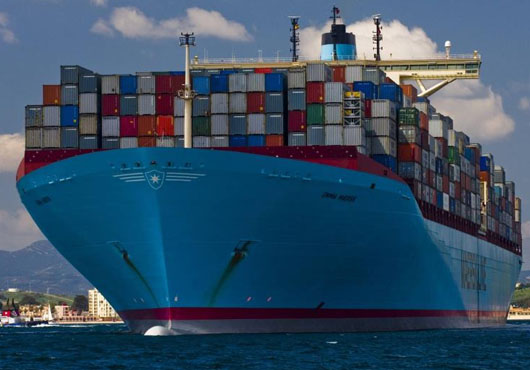
BEIJING: Maritime and air freight rates for some of the world’s busiest trade routes are tumbling as slower growth in China combined with a sluggish eurozone economy dash forecasts for higher volumes during the normally busy late-summer season.
Ship operators on key Europe-to-Asia circuits have been struggling for a while with falling rates amid lingering overcapacity from the global economic crisis. This time of the year typically provides a lift as retailers of Asian-made goods—items as diverse as toys, clothing and electronics—start to move cargoes ahead of the end-of-year holidays in Europe and North America.
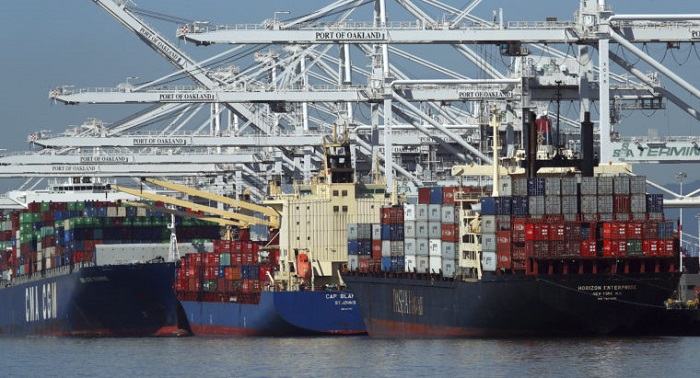

This year that gift-giving bounce hasn’t yet materialized, and market watchers are blaming lower demand from Europe, as well as an easing Chinese appetite for luxury items and other imports. Shipping brokers in London and Singapore said last week’s devaluation of the yuan already is having a profound effect on shipments of luxury goods from Europe.
“We are seeing shipments of luxury items like handbags, branded clothing and shoes down by around 17% since the devaluation,” said one broker, adding that the stock market’s meltdown would make Chinese and Hong Kong consumers even more jittery. He said shipments of upmarket European cars are also dropping, though would take a few weeks to determine the impact.
The outlook for airfreight, which shippers rely on for more time-sensitive goods like pharmaceuticals, flowers and electronics, also is souring. Martin Dixon, director of research at Drewry Shipping Consultants Ltd., said the firm now expects global air-cargo traffic to stagnate for the year, after initially projecting growth. A big weight is falling demand in China and Asia.
China accounts for about 20% of global air exports by weight, and 10% of global air imports, according to advisory and merchant-banking firm Seabury Group LLC.
Air-cargo shipments passing through Hong Kong, for instance, slumped 2% last month, Mr. Dixon said. Prices across 21 global routes have fallen 27% since November to a record low in June, his consultancy said.
The air-cargo market is suffering on several fronts. Lower demand in Asia is coming at the same time air-cargo capacity is climbing. A large chunk of the air-cargo market is transported in the hold of passenger planes. With major airlines adding flights globally this year, that is weighing on cargo rates. Falling fuel costs also are delaying plans by airlines to retire older jets, exacerbating the problem.
“With capacity continuing to rise, supported by strong passenger demand, the industry faces a challenging period of weak load factors and low yields,” said Mr. Dixon. “And with jet-fuel costs set to fall further, we expect airfreight pricing to weaken further.”
At sea, the cost to ship a container from Shanghai to Rotterdam in the Netherlands fell 27% this week to $469, according to data by the Shanghai Containerized Freight Index. It was the third straight week of weakening rates, which have now slumped close to 60% since late July—the last time carriers succeeded in boosting rates, albeit temporarily.
Containers to and from China and Hong Kong represent 30% of global traffic, according to Drewry, which earlier this month cut its 2015 growth forecast for boxes moving through Chinese and Hong Kong ports to 4.9%, from a 5.8%. That is the equivalent of removing 1.85 million 20-foot containers, or 1% of world-wide container traffic, from ocean trade lanes.
“Going into 2015, our expectation was [for] around 3% growth, but the reality is that the market has contracted by 3% year to date,” said Michael Storgaard, a spokesman at Maersk Line, the shipping unit of Danish conglomerate A.P. Moeller-Maersk A/S and the world’s biggest container operator.
China, meanwhile, is the world’s biggest importer of coal and iron ore, and freight rates for so-called dry bulk vessels that carry such goods are suffering. The Baltic Dry Index fell to 968 points on Tuesday from 1,222, at the beginning of August.
“The past month has been brutal for both the dry bulk and container markets,” said Basil Karatzas, who runs New York-based Karatzas Marine Advisors & Co. “The slowing Chinese economy is exacerbating overcapacity problems at a time when trade is supposed to be picking up.”