Customs Today
  • Home
  • Islamabad
  • Karachi
  • Lahore
  • National
  • Transfers and Postings
  • Chambers & Associations
  • Business
No Result
View All Result
Customs Today
  • Home
  • Islamabad
  • Karachi
  • Lahore
  • National
  • Transfers and Postings
  • Chambers & Associations
  • Business
No Result
View All Result
Customs Today
No Result
View All Result
Home Science & Technology Science

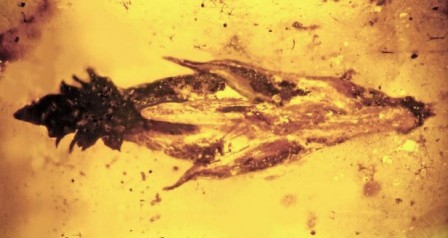
Grass spikelet, ergot-like parasitic fungus preserved in 100-million-year-old piece of amber from Myanmar

byCustoms Today Report
11/02/2015
in Science, Science & Technology
Share on FacebookShare on Twitter

NEW YORK: An international team of paleontologists led by Dr George Poinar of Oregon State University has found a grass spikelet and an ergot-like parasitic fungus preserved in a 100-million-year-old piece of amber from Myanmar.

Ergot has played roles as a medicine, a toxin, and a hallucinogen; been implicated in everything from disease epidemics to the Salem witch trials; and more recently provided the drug LSD.


You might also like

Tesla driverless system to use updated radar technology

12/09/2016

Apple to develop its own self-driving technology

10/09/2016

Apparently both ergot and the grasses that now form most of the diet for the human race evolved together.

“It seems like ergot has been involved with animals and humans almost forever, and now we know that this fungus literally dates back to the earliest evolution of grasses,” said Dr Poinar, who is the first author of a paper accepted for publication in the journal Palaeodiversity.

The newly-discovered amber fossil dates about 100 million years ago to the middle Cretaceous, when the land was still dominated by dinosaurs and conifers, but the earliest flowering plants, grasses and small mammals were beginning to evolve.

“This is an important discovery that helps us understand the timeline of grass development, which now forms the basis of the human food supply in such crops as corn, rice or wheat.”

“But it also shows that this parasitic fungus may have been around almost as long as the grasses themselves, as both a toxin and natural hallucinogen.”

“There’s no doubt in my mind that it would have been eaten by sauropod dinosaurs, although we can’t know what exact effect it had on them.”

The fungus in this specimen was named Palaeoclaviceps parasiticus. It’s very similar to the fungus Claviceps, commonly known as ergot.


Tags: 100m yrs old Burmese amberDr George PoinarDr Poinarinternational team of paleontologistsjournal Palaeodiversity.Oregon State Universitypreserves fungus infected grass

Related Stories

Tesla driverless system to use updated radar technology

byCT Report
12/09/2016

WASHINGTON: Electric carmaker Tesla announced Sunday it was upgrading its Autopilot software to use more advanced radar technology. In a...

Apple to develop its own self-driving technology

byCT Report
10/09/2016

SAN FRANCISCO: Apple may not become an automaker, but it still wants to develop its own self-driving technology. The iPhone-maker's...

NASA spots slowest known magnetar

byCT Report
10/09/2016

WASHINGTON: Astronomers have found evidence of a magnetar - magnetised neutron star - that spins much slower than the slowest...

‘YouTubers’ outshining old-school television

byCT Report
09/08/2016

SAN FRANCISCO: A media revolution is taking place, and most people over 35 years of age aren’t tuned in. Millennial...

Next Post

Super Smash Bros for Nintendo 3DS receives update enabling amiibo functionality with data loss

  • Terms and Conditions
  • Disclaimer

© 2011 Customs Today -World's first newspaper on customs. Customs Today.

No Result
View All Result
  • Transfers and Postings
  • Latest News
  • Karachi
  • Islamabad
  • Lahore
  • National
  • Chambers & Associations
  • Business
  • About Us

© 2011 Customs Today -World's first newspaper on customs. Customs Today.