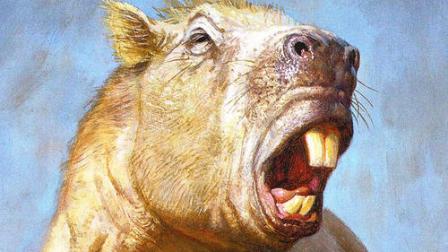
LONDON: Scientists have discovered that the largest-known rodent to have ever roamed Earth had ferocious front teeth useful for fighting and digging much in the way that elephants today use their tusks.
Josephoartigasia monesi, described in the Journal of Anatomy, weighed an estimated 2,200 pounds. Even though it had roughly the mass of a buffalo, its close modern-day relatives include the more modestly sized guinea pig.


This enormous rodent, discovered in Uruguay and described in a paper in 2008, lived in South America about 3 million years ago, probably around estuaries or deltas near forested areas. And it wasn’t the only monstrous animal around at the time, according to the earlier paper.
“The possible associated fauna include other giant rodents, sabre-toothed cats, giant carnivorous birds, xenarthrans, capybaras and assorted ungulates,” Andres Rinderknecht of the National Museum of Natural History and Anthropology and Ernesto Blanco of the Institute of Physics, both in Montevideo, Uruguay, wrote in the 2008 paper.
Aside from its size, one of the mega-rodent’s standout features are its enormous front teeth. Long, sharp incisors are a common feature among the rodent order (think of beaver, squirrel and prairie-dog teeth, for example), but the ones on Josephoartigasia monesi looked like they could do a lot of damage. But what were these fearsome chompers used for?
To find out, Philip G. Cox at the University of York and the 2008 study authors put the fossil through a CT scan, created a computer reconstruction of the skull and modelled the stresses and strains that it could take. The scientists found that the animal’s bite forces were large, around 1,400 newtons, which is similar to the bite force of a tiger. But the incisors would have been able to bear forces nearly three times as large, according to the 2008 paper.
This could mean that the incisors were used for more than just biting _ perhaps for digging up food or fighting off predators, according to the researchers.
“These results, combined with previous work, lead us to speculate that J. monesi was behaving in an elephant-like manner, using its incisors like tusks, and processing tough vegetation with large bite forces at the cheek teeth,” the study authors wrote.