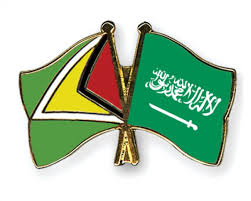
GEORGETOWN: Guyana’s President David Granger held bilateral discussions with Saudi Arabia’s King Salman Bin Abdulaziz Al Saud on the sidelines of the fourth summit of Arab and South American Countries (ASPA) in Riyadh, when they “discussed a number of issues on the agenda of the summit, in addition to issues of common interest between the two countries.”
The meeting was also attended by Saudi minister of state, Dr Muasaed Al-Aiban; minister of foreign affairs, Adel Al-Jubeir; acting chief of the royal court, Khalid Al-Essa; and Guyana’s minister of foreign affairs, Carl Greenidge.
Guyana, a small state, is keen to enhance its multilateral diplomacy as a strategy to defend its territorial integrity, amidst renewed claims to its territory by two of its neighbours, Suriname and Venezuela. With a small army, and lack of conventional weapons, the new government of Guyana is looking to participate more in multilateral forums.
In Riyadh, Granger said, “We support the thrust of the Arab and South American partnership, which was initiated by former president of Brazil, Lula Da Silva 12 years ago. We feel that it a very useful forum for building international cooperation.”
The new Guyanese leader, who came to office earlier this year, also recommitted Guyana’s support for Palestinian sovereignty and statehood. From the South America bloc, “The main issue that was raised was that of Argentina’s claims on the Falkland Islands.”
“Guyana reserved its old position in this regard,” Granger said in a press release.
A major oil discovery in Guyana’s offshore waters has increased tensions with neighbouring Venezuela, which has laid claim to the offshore oil. Guyana has accused Venezuela of “economic terrorism”.
Caracas has used its military power against Guyana, its tiny neighbour, to stymie economic development by use of force and intimidation to drive investors out, according to the government of Guyana.
Of importance to Guyana, the final communiqué at the end of the summit on Wednesday stressed “the importance of respecting the unity, sovereignty and independence of the states and territorial integrity and resolving conflicts peacefully.”
This is an issue that Granger raised during his presentation at the summit on Wednesday.
The Venezuela-Iran-Syria alliance continues to be a major headache for these countries in the Gulf. And Guyana’s backing of Kuwait at the United Nations during the Iraqi invasion of that country is one reason why Kuwait and Guyana ties are strong. Kuwait continues to subsidize the Guyana embassy in its capital.
The Saudi-Iran rift runs so deep that Saudi Foreign Minister Abel Al-Jubeir told Al-Arabiya News Channel on Wednesday that “Arab countries’ rapprochement with South American countries will increase Iran’s isolation in the world.” He also praised South American countries for their support of Arab causes.
“Iran seeks to establish relations with these countries due to its weak international position and because it does not have many friends across the world,” Al-Jubeir said.
Venezuela’s President Nicolas Maduro, who attended the summit, made no progress on his insistence on “a formula agreed between oil-producing countries to recover the price of crude oil.” The Sunni Arab Gulf states can withstand the sharp drop in oil price, but in Venezuela there is an acute shortage of food. Moreover, an increase in oil price will be of tremendous benefit to Iran and that’s something the Gulf States clearly want to avoid.
Guyana, seeking investments from the Arabian Gulf, is pushing ahead with “economic diplomacy” and has touted the idea of setting up an investment office in the Gulf. It is this focus on “economic diplomacy” why Granger chose Greenidge, a former minister of finance, planning and trade as his top diplomat.
Both Guyana and its neighbour, Suriname, are lagging behind in developing trade and investment with the Arab region as compared to their South American neighbours. Trade between South America and the Arab bloc has now reached over $30 billion from only $6 billion in 2005.
King Salman, in his address to the gathering, proposed setting up a “joint business council,” which would promote economic relations between the Arab League nations and the Union of South American Nations (UNASUR).
The Saudi monarch praised the relationship between the two blocs as “extraordinary.” He called on the leaders to “bolster cooperation in all areas.” He also proposed an agreement to avoid double taxation to promote trade and investment.
Venezuela offered to host the next ASPA summit in 2018.

Guyana Gold Board reopens Bartica office
GEORGETOWN: Government reopened the Guyana Gold Board (GGB) office in Bartica, Region Seven, more than a year after closing it...