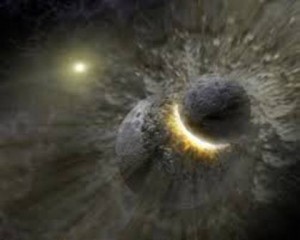

PARIS: Powerful collisions between the young Earth and iron-rich objects within the solar system would have resulted in significant amounts of iron vapor, a study by researchers at the Lawrence Livermore National Laboratory in Berkeley, Calif., suggests.
This vapor would have settled onto the earth as an “iron rain” that may also have brought many iron-loving elements like gold, platinum and palladium into Earth’s rocky outer shell, explaining why they became common enough for humans to mine and use, they report in the journal Nature Geoscience.
However, scientists have never had good model for what happens to colliding bodies when impact speeds are high enough to put materials under the resulting extreme pressures, they acknowledge.
“One major problem is how we model iron during impact events, as it is a major component of planets and its behavior is critical to how we understand planet formation,” says LLNL scientist Richard Kraus said. “In particular, it is the fraction of that iron that is vaporized on impact that is not well understood.”
To find out, Kraus and his colleagues used a machine at the Sandia National Laboratory in New Mexico that utilizes magnetic fields to accelerate metals to extreme speeds.
They fired small iron samples at aluminum plates at impact speeds of 30,000 miles per hour, with the collisions sending powerful shock waves into the iron, making it compress, heat up and turn to vapor.

Tesla driverless system to use updated radar technology
WASHINGTON: Electric carmaker Tesla announced Sunday it was upgrading its Autopilot software to use more advanced radar technology. In a...