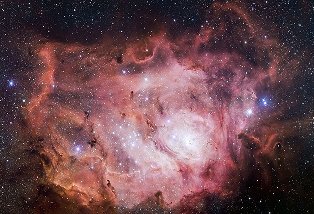

CANADA: Normally hidden from view, the heart of Lagoon Nebula is filled with intense stellar tempests generated by hot stars, churning funnels of glowing gas, and energetic star formation.
Also known as Messier 8 and NGC-6523, the Lagoon Nebula is located about 4100 light-years away in the constellation Sagittarius.
The nebula covers a massive area of space over 110 light-years wide and consists of an intricate haze of ionised hydrogen gas and pitch-dark dust clouds.
This new image from the Hubble Space Telescope combines optical with infrared wavelength that help astronomers peer through the dense clouds of gas and dust to reveal the more intricate structures underneath.
However, even in optical light, the tranquil name remains misleading as the region is engulfed in violent phenomena.
The bright star embedded in dark clouds at the centre of our image is Herschel 36, a massive blue star many times larger than the Sun.
Herschel 36 is responsible for sculpting the surrounding clouds and stripping away material. The star pumps out huge amounts of ionising ultraviolet radiation that knocks electrons loose from their atoms in the surrounding hydrogen gas.
The central part of the Lagoon Nebula, visible in the middle third of our image, contains two main structures of gas and dust connected by several wispy tornadoes.
Like their counterparts on Earth, these twisters are thought to be wrapped into their funnel-like shapes by temperature differences between the glowing hot surface and cold dark interior of the clouds.
The nebula is also actively forming new stars, and the energetic winds generated by these newborns are also thought to contribute to the twisters.
This image combines data taken using optical and infrared light gathered by Hubble’s Wide Field Planetary Camera 2.

Tesla driverless system to use updated radar technology
WASHINGTON: Electric carmaker Tesla announced Sunday it was upgrading its Autopilot software to use more advanced radar technology. In a...