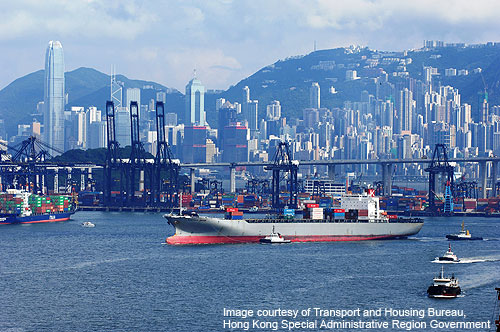
HONG KONG: Due to constant overcrowding of Hong Kong ports, the government has sought more land as the congestion has been on a very critical stage. Thus to cope with this issue, the government is looking for more land to expand the transshipment volumes and increase the space in the port.
In the “Study on the Strategic Development Plan for Hong Kong Port 2030”, made public by the Transport and Housing Bureau this week, report authors BMT Asia-Pacific said to cope with the port’s projected future throughput, container handling measures had to be improved.

BMT briefed Hong Kong Port Development Council and the Hong Kong Maritime Industry Council members on the findings of the study.
“The industry generally agreed with the consultants’ proposals and has requested the administration implement the enhancement measures as soon as possible to provide more port backup land and berthing facilities to relieve congestion at the Kwai Tsing container port,” a Transport and Housing Bureau spokesman said. An industry consultation study looking at land utilisation in the port area is expected to be completed by mid-2015.
BMT forecast that container throughput in Hong Kong would grow by 1.5 percent a year and reach 31.5 million 20-foot containers by 2030, with the growth coming from international transshipment while South China exports would record negative growth.
From almost 80 percent in 2001, Hong Kong’s share of the more economically valuable South China direct export cargo fell to below 40 percent by 2011 even as its international transshipment cargo grew to almost 75 percent of the port’s annual throughput.
“As a result of competition from other South China ports, Hong Kong’s market share for South China cargo has declined, but the rate of decline is diminishing,” the study authors said. “However, throughput related to South China is no longer the main driver of growth in Hong Kong’s throughput.”
This changing cargo mix is having a serious structural impact on the port and comes at a time of when the shipping industry is embracing economies of scale. Hong Kong’s container terminals have been operating at critical levels of congestion since September as the port struggles to handle the growing levels of transshipment cargo arriving on larger ships that are staying in port for longer.
As a major regional hub, the lines are deploying the largest vessels in Hong Kong, which bring surges in container volumes being loaded and off-loaded. The big east-west alliances were also finalized this year, and the 2M, O3, G6 and CKYHE vessel tie-ups now call at multiple terminals. When a ship arrives in a transshipment hub such as Hong Kong, the boxes on board belong to five or six lines and require thousands of inter-terminal moves to get the containers to their carriers or feeder ships. Cargo Smart data reveals that in the past year, the average arrival delays for vessels with of 10,000 TEU and up was 24 hours.
Growing barge traffic is another key issue contributing to congestion in Hong Kong. During 2001 to 2011, river throughput recorded an average annual growth of 4.1 percent, faster than the 2.8 percent for ocean throughput. River barges are far cheaper than trucking containers across the border into Hong Kong, and with a manufacturing shift to the western bank of the Pearl River, barging exports boxes to Hong Kong container terminals is cheaper than using Shenzhen ports.
“Depending on the facilities available at any particular time, river barges are accommodated both at the main berths, provided there is no requirement for an ocean vessel to use the berth, and the designated barge berths included in some of the terminals,” the study found.
However, a shortage of dedicated barge berths at the container terminals as longer ships take up additional space and squeeze them out is leading to lengthy barge delays.
Hong Kong Shippers’ Council executive director Sunny Ho said part of the problem was that the original design of the Hong Kong terminals and berths was about half that of newly constructed terminals that could better cater to the larger vessels.
“The government has multiple challenges to address,” he said.