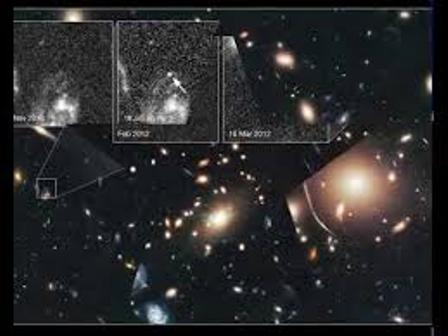

NEW YORK: The Hubble Space Telescope has produced a rare quadruple image of an exploding star through what a Reuters report calls a “naturally occurring cosmic magnifying lens.”
The four simultaneously occurring images were created by way of light taking multiple paths around a huge galaxy cluster located between the explosion and Hubble. The galaxy cluster’s gravity caused the light to bend around it.
Albert Einstein predicted that light would travel through space under effects such as this. The quadruple image created by the light-bending effect is called an “Einstein Cross,” first coined when a quasar produced multiple images.
This effect, known as gravitational lensing, has been capitalized upon by Hubble scientists to enable the telescope to spot celestial bodies even further back in time than might be possible without such gravitationally bent light.
The light’s behavior will also help astronomers estimate the extent of dark matter distribution in the area that caused the lensing effect. Dark matter is visually undetectable but scientists believe it accounts for most of universe’s mass.

Tesla driverless system to use updated radar technology
WASHINGTON: Electric carmaker Tesla announced Sunday it was upgrading its Autopilot software to use more advanced radar technology. In a...