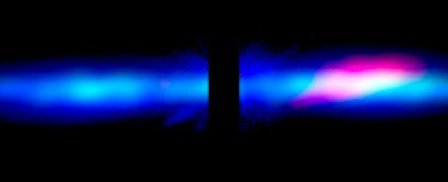

HONG KONG: Astronomers have used NASA’s Hubble Space Telescope to take the most detailed edge on picture to date of a large disk of gas and dust encircling the 20 million-year-old star Beta Pictoris.
Beta Pictoris is the only star to date where astronomers have detected an embedded giant planet in a directly-imaged debris disk.
The planet, which was discovered in 2009, goes around the star once every 18 to 20 years.
This allows scientists to study in a comparably short time how a large planet distorts the massive gas and dust encircling the star.
These observations should yield new insights into how planets are born around young stars.
“The new images reveal the inner disk and confirm the predicted structures. This finding validates models that will help us to deduce the presence of other exoplanets in other disks,” explained Daniel Apai from the University of Arizona, Tucson.
The new visible-light Hubble image traces the disk to within about 650 million miles of the star.
The giant planet orbits at 900 million miles, and was directly imaged in infrared light by the European Southern Observatory’s Very Large Telescope six years ago.
When comparing the latest images to Hubble images taken in 1997, astronomers find that the disk’s dust distribution has barely changed over 15 years despite the fact that the entire structure is orbiting the star like a carousel.
This means the disk’s structure is smooth and continuous, at least over the interval between the Hubble observations.
In 1984, Beta Pictoris was the very first star discovered to be surrounded by a bright disk of dust and debris.
Since then, Beta Pictoris has been an object of intense scrutiny with Hubble and ground-based telescopes.
Beta Pictoris is 63 light-years away, closer to the Earth than most of the other known disk systems.

Tesla driverless system to use updated radar technology
WASHINGTON: Electric carmaker Tesla announced Sunday it was upgrading its Autopilot software to use more advanced radar technology. In a...