
Customs Today
  • Home
  • Islamabad
  • Karachi
  • Lahore
  • National
  • Transfers and Postings
  • Chambers & Associations
  • Business
No Result
View All Result
Customs Today
  • Home
  • Islamabad
  • Karachi
  • Lahore
  • National
  • Transfers and Postings
  • Chambers & Associations
  • Business
No Result
View All Result
Customs Today
No Result
View All Result
Home Science & Technology Science

Hubble Space Telescope image revealed surprising details of the nebula ejection process

byCustoms Today Report
20/05/2015
in Science, Science & Technology
Share on FacebookShare on Twitter

You might also like

Tesla driverless system to use updated radar technology

12/09/2016

Apple to develop its own self-driving technology

10/09/2016

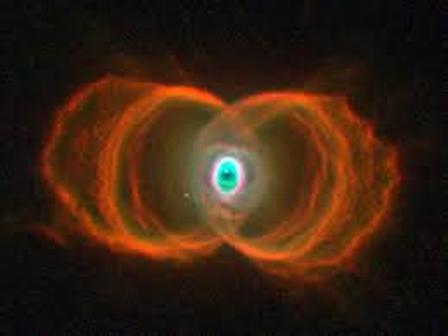
NEW YORK: MyCn 18 is a young planetary nebula located in the southern constellation Musca, about 8000 light-years from Earth.
The term ‘planetary nebula’ is actually a misnomer coined by astronomer William Herschel in the 1780s, when he first saw one of these objects through a telescope and thought they resembled the rounded shape of a planet.
The star that created MyCn 18 started life as a low mass star like our Sun.
Over billions of years it expanded to become a red giant. Once its nuclear fuel was expended, its gaseous outer envelope puffed off into space, exposing its white hot core at the centre of the image.
This core is destined to slowly cool down over the eons as a white dwarf star.
The unprecedented sharpness of this Hubble Space Telescope image has revealed surprising details of the nebula ejection process, helping scientists to resolve some of the outstanding mysteries of the complex shapes and symmetries of planetary nebulas.
Astronomers think the hourglass shape is produced by the expansion of a fast stellar wind within a slowly expanding cloud that is denser near its equator than its poles.
The nebula’s glowing delicate rings outline the tenuous walls of the hourglass.
Nitrogen lights up in red, hydrogen in green and oxygen in blue.
It is predicted that our Sun will meet the same fate in around six billion years. When our Sun becomes a red giant, its outer envelope expands to engulf Mercury, Venus, and almost certainly, the Earth as well.
This artificially colourised image was taken with the Wide Field and Planetary Camera 2 aboard NASA’s Hubble Space Telescope.

Related Stories

Tesla driverless system to use updated radar technology

byCT Report
12/09/2016

WASHINGTON: Electric carmaker Tesla announced Sunday it was upgrading its Autopilot software to use more advanced radar technology. In a...


Apple to develop its own self-driving technology

byCT Report
10/09/2016

SAN FRANCISCO: Apple may not become an automaker, but it still wants to develop its own self-driving technology. The iPhone-maker's...

NASA spots slowest known magnetar

byCT Report
10/09/2016

WASHINGTON: Astronomers have found evidence of a magnetar - magnetised neutron star - that spins much slower than the slowest...

‘YouTubers’ outshining old-school television

byCT Report
09/08/2016

SAN FRANCISCO: A media revolution is taking place, and most people over 35 years of age aren’t tuned in. Millennial...

Next Post

Why airplane food tastes bad: Loud noise while flying affects the way we perceive flavour, study

  • Terms and Conditions
  • Disclaimer

© 2011 Customs Today -World's first newspaper on customs. Customs Today.

No Result
View All Result
  • Transfers and Postings
  • Latest News
  • Karachi
  • Islamabad
  • Lahore
  • National
  • Chambers & Associations
  • Business
  • About Us

© 2011 Customs Today -World's first newspaper on customs. Customs Today.