
LONDON: Research by the University of Liverpool has found that the same brain activity is used for language production and making complex tools, supporting the theory that they evolved at the same time.
Though our ability to use language is one of the central things that distinguish humans from other animals, scientists are uncertain about why and when this trait evolved. Now, a team of researchers studying the development of ancient tools suggests the evolution of language may have been tied directly to toolmaking. According to the new study, our ancestors may have developed a primitive form of language in order to teach each other to make stone tools, a skill that proved to be crucial to their survival.
As it’s impossible to track words and linguistic ability directly through the archaeological record, scientists have previously attempted to study the evolution of language through “proxy indicator” skills, such as early art or the ability to make more sophisticated tools. The authors of the new study, a team of scientists led by Thomas Morgan, a psychologist at the University of California, Berkeley, took a different approach. Rather than consider toolmaking solely a proxy for language ability, the team explored how language might help modern humans learn to make tools using the same techniques their early ancestors did.
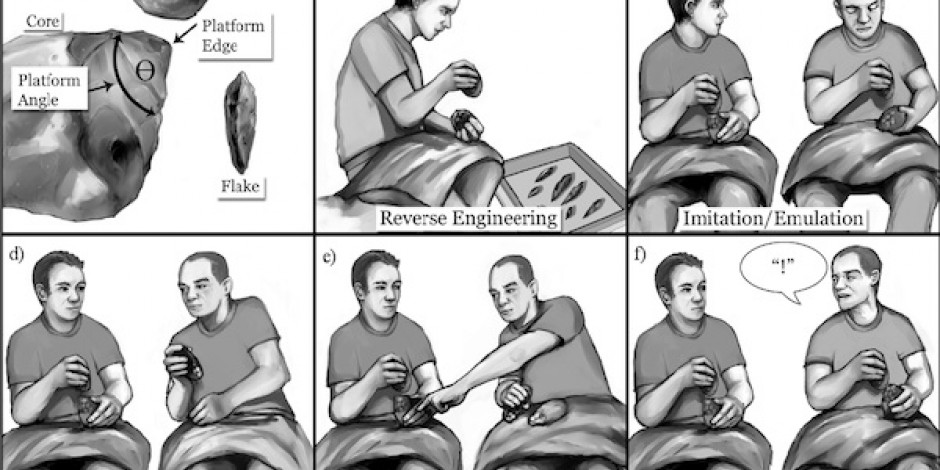
In the experiment, the scientists took 184 volunteers—students from the University of St. Andrews in the United Kingdom—and broke them into five groups; archaeologists then instructed the first person in the technique known as Oldowan stone-knapping. Oldowan tools, named for the famous Olduvai Gorge in Tanzania, where archaeologists Louis and Mary Leakey discovered the implements in the 1930s, were widespread among early humans between 2.5 and 1.8 million years ago. The technique consisted of striking a stone “hammer” against a stone “core” to flake off pieces and create a sharp edge that could be used to cut, chop and scrape; the flakes themselves were also sharp enough to use for cutting plants and butchering animals.
Each of the five groups proceeded in different ways: In the first, a pair of volunteers were simply given the stone “core,” a hammer and some examples of flakes, then told to go about their business without guidance. In the second group, the second student learned how to make the tools by simply watching his fellow volunteer (who had been taught the technique) and trying to duplicate his actions without communication. In the third, the volunteers showed each other what they were doing but with no talking or gesturing. The fourth group was allowed to gesture and point, while in the fifth group, the “teacher” was allowed to say whatever he or she wanted to the other volunteers. In the next round of the experiment, the learner became the teacher, creating five different “chains” of transmission; in all, the volunteers produced more than 6,000 stone flakes.
According to the results of the study, published this week in the journal Nature Communications, the first group predictably had very little success when left to their own devices. What was striking, however, was that performance improved very little among those who simply watched their fellow volunteers make the tools. Only those who were allowed to gesture and talk while teaching performed significantly better than the baseline the scientists had established. By one measurement, gesturing doubled the likelihood that a student would produce a viable stone flake in a single strike, while verbal teaching quadrupled that likelihood.

Tesla driverless system to use updated radar technology
WASHINGTON: Electric carmaker Tesla announced Sunday it was upgrading its Autopilot software to use more advanced radar technology. In a...