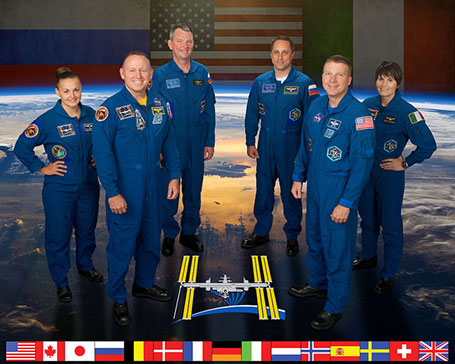
NEWYORK: ISS Expedition 42 has successfully used a 3-D printer in space for the first time. The first part manufactured in space was a faceplate for the printer itself. The current printer is designed for experimentation with 3-D printing, also known as additive manufacturing, in space. The results of the initial experiments will be used to design and build a second printer scheduled to arrive at the ISS in 2015.
“This first print is the initial step toward providing an on-demand machine shop capability away from Earth. The space station is the only laboratory where we can fully test this technology in space,” said Niki Werkheiser, project manager for the International Space Station 3-D Printer in a statement.


In addition to decreasing the cost and increasing the delivery speed of parts and supplies for the ISS, the technology could prove invaluable when NASA begins sending missions deeper into space. 3-D printing technology is an essential component of plans by the Mars Foundation and others to build human colonies on Mars.
“The operation of the 3-D printer is a transformative moment in space development. We’ve built a machine that will provide us with research data needed to develop future 3-D printers for the International Space Station and beyond, revolutionizing space manufacturing. This may change how we approach getting replacement tools and parts to the space station crew, allowing them to be less reliant on supply missions from Earth,” said Aaron Kemmer. Kemmer is the, chief executive officer of Made in Space, the private sector company that worked with NASA to design and build the printer.
According to NASA, part adhesion on the tray was much stronger than anticipated. Later tests will determine whether this is an anomaly or a result of the way 3-D printed layers adhere to one another in microgravity.
“This is the first time we’ve ever used a 3-D printer in space, and we are learning, even from these initial operations. As we print more parts we’ll be able to learn whether some of the effects we are seeing are caused by microgravity or just part of the normal fine-tuning process for printing. When we get the parts back on Earth, we’ll be able to do a more detailed analysis to find out how they compare to parts printed on Earth,” said Werkheiser.
In addition to standard parts which can be stored in memory, instructions for new parts can be sent to the 3D printer from the ground. For these experiments instructions for products produced by the printer are being sent to the device by ground control and not my ISS crew members.