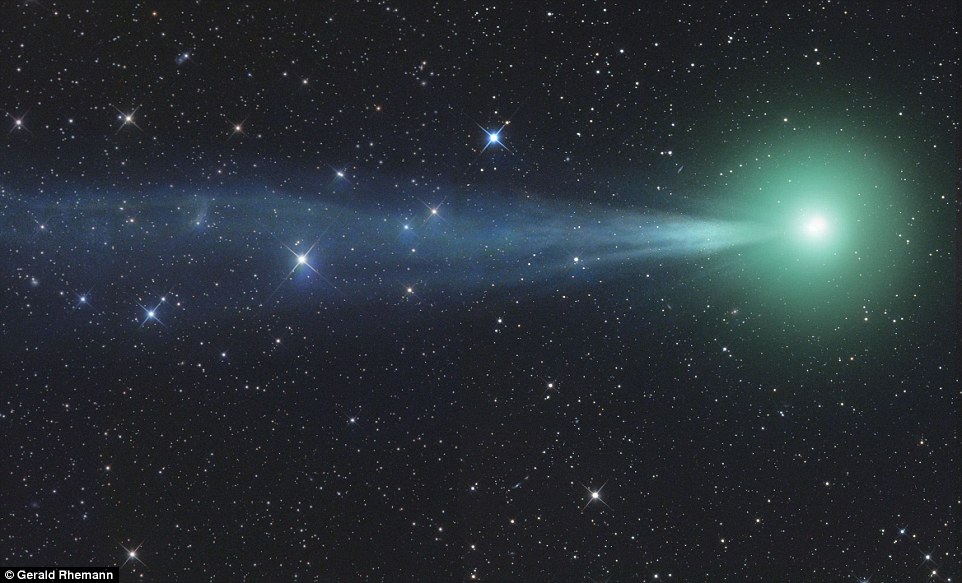

PARIS: The first 2015 comet visible to the naked eye can be seen striking across the sky for most of January, Slate’s Phil Plait reports.
The comet made its closest approach to Earth passing just over 70 million kilometres away last week and will be visible until around 24 January.
Astroblogger Dr Ian Musgrave says Lovejoy is bright enough for sky watchers with clear, dark skies to view it with the unaided eye — although it is best viewed through a telescope.
“Lovejoy can be best found by looking just below and to the left of the constellation Orion (known colloquially in Australia as ‘the saucepan’ ) in the northern sky,” says Musgrave.
“It is visible from anywhere in Australia and most of the southern hemisphere at the moment, but now people in the northern hemisphere will begin to get a better view.
“But don’t wait too long to check out Lovejoy, as moonlight will begin to interfere with your view by the end of the month,” he says.
The comet, which was discovered in 2014 by amateur Australian astronomer Terry Lovejoy, comes from the Oort Cloud, a distant halo of icy bodies and frozen debris at the outer edge of the solar system.
It last visited the inner solar system about 11,500 years ago and is not expected to return for another 8000 years.
The coma’s green glow is caused by carbon molecules, which are made to fluoresce by ultraviolet radiation from the Sun.
Comets usually have two tails — a dust tail, and an ion tail, but Lovejoy isn’t producing enough dust to generate a visible dust tail.
Its long ion gas tail is tinted blue because of fluorescing carbon monoxide ions.
The limited dust which is flowing through the comet’s coma and tail reflects sunlight, producing a pale yellowish white glow.

Tesla driverless system to use updated radar technology
WASHINGTON: Electric carmaker Tesla announced Sunday it was upgrading its Autopilot software to use more advanced radar technology. In a...