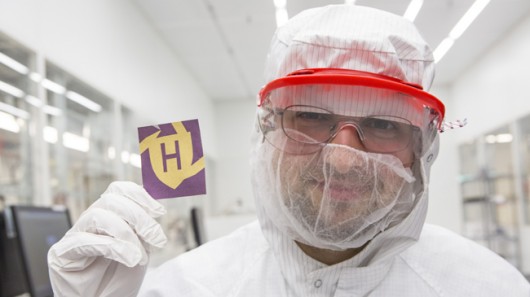

MEXICO: Mikhail Kats the PhD student from Harvard University’s Laboratory for Integrated Science and Engineering has recently created a new lightweight, low-cost coloring technology for both rough and smooth surfaces.
An ultra-thin conductive metal coating that can be used with any material to make flexible smart clothes or efficient solar cells or light weight industrial paint, said researchers.
The technology developed by PhD student Mikhail Kats and his advisory Prof. Federico Capasso, involves use of a machine known as an electron-beam evaporator to vaporize pieces of metal, by striking them with a stream of electrons
Researchers further explaining the technology said that these vapors travel in the upward direction through a vacuum chamber within the evaporator, and gets collected on the surface of a metallic item placed at the top.
By repeating this process, they can deposit a multiple layers on the item and get an ultra-thin coating.
In order to test the technology, Kats coated a piece of paper with a film made up of gold and germanium. He found that the paper remained flexible, even after the coating was applied onto it.
The color of the paper appeared to be the same when viewed from different angles. The rough surface within its microstructure added some subtle variation to the light-scattering process, said researchers.
They suggested that with the help of a different technique, they will be able to make the color appear completely uniform from any angles.
Previous studies had shown that the technique worked on smooth surfaces, this was the first time that the experiment was successfully applied to a rough surface.
Kats said, “This is way of coloring something with thin layer of material, so if it’s metal to begin with, you can just use 10 nanometers to color, if it’s not, you can deposit metal 30 nm thick and another 10 nm”.

Tesla driverless system to use updated radar technology
WASHINGTON: Electric carmaker Tesla announced Sunday it was upgrading its Autopilot software to use more advanced radar technology. In a...