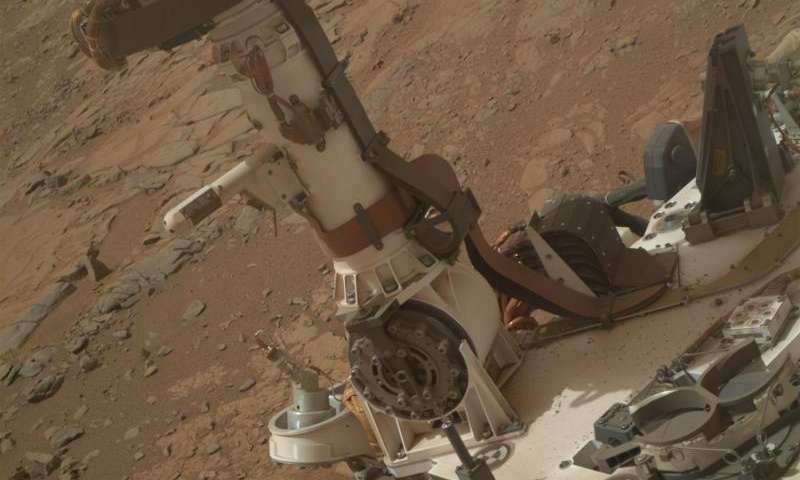
LONDON: NASA’s Curiosity rover has discovered that conditions on Mars are “favorable” to producing briny water in the soil, which could in turn imply that water could form all over the surface of the Red Planet if certain conditions are met.
Scientists found that the soil in the Gale Crater of Mars contained perchlorate, a salt that acts as a kind of anti-freeze by absorbing water vapor from the atmosphere, lowering the freezing temperature of the water.


Curiosity’s latest findings — published as a study in Nature Geosciences — have led NASA scientists to suggest that, during certain cold nights, the temperature and humidity levels are just right for brine to form in the soil, drying out after sunrise.
Liquid water is a requirement for life, the study’s lead author Javier Martin-Torres said. But the data doesn’t mean the rover will unearth E.T. on its next mission.
“Conditions near the surface of present-day Mars are hardly favorable for microbial life as we know it, but the possibility for liquid brine on Mars has wider implications for habitability and geological water-related processes,” he said.