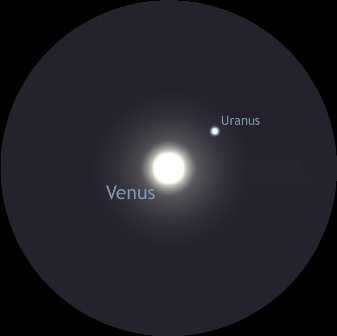


WASHINGTON: Occurring exactly a week after its close pairing with Venus, Uranus’ conjunction with Mars is somewhat wider and the contrast in brightness not so great, but the pair’s proximity to the horizon in deep twilight means that you’ll need to pick your time carefully to see them so that the sky will be dark enough to see Uranus, but not so late that the pair will be too close to the horizon. An hour after sunset is about the ideal time, something you can determine with our Almanac.
As with last week’s event, let Venus be your guide. Mars and Uranus will lie 8° (about the apparent length of your thumb with your arm outstretched) to the lower right of the brightest planet.
The separation of Mars and Uranus will be just ¼°, half the apparent size of the Full Moon. In your telescope, choose an eyepiece that gives you about 50x magnification (tip: our Scope Calc can help with eyepiece selection) so that you have a field of view close to one degree, if possible.
The close proximity of Mars makes finding Uranus easy since they will be in the same low-power telescopic field of view, but their difference in brightness will be 4.6 magnitudes, or 70 times.

Pakistan to get $3b loan from Islamic Trade Financing Corporation
ISLAMABAD: Islamic Trade Financing Corporation (ITFC) to provide Pakistan with a $3 billion loan, according to an official statement released...