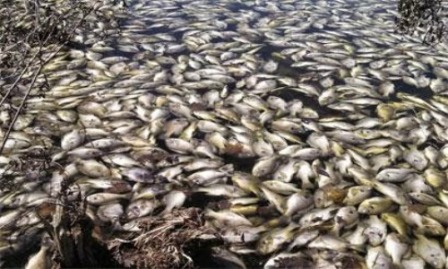
WASHINGTON: A new study of mass die-offs amongst animal species shows a marked increase in deaths of birds, fish and marine invertebrates.
In a multi-institutional study researchers from University of San Diego, Yale University and the University of California Berkeley examined over 2,400 animal populations that experienced 727 of these massive animal die-offs, known as Massive Mortality Events (MME) that occurred between 1940 and 2010, and what the data revealed is alarming for scientists and conservationists around the world. While the rate of massive animal die-offs seemed to remain some what steady over that 50 year period, fish, birds, and marine invertebrates saw a shocking increase in frequency and magnitude.


The study also revealed that a large portion of these animal die-offs were occurring in relation to human created activities that result in wide spread environmental pollution and contamination of local habitats.
The results of the study were published in an issue of Proceedings of the National Academy of Sciences, and the co-author of the study on animal die-offs and assistant professor of biology at the University of San Diego, Adam Siepielski, released a statement regarding their findings.
“The increase in mass mortality events (MMEs) appears to be associated with a rise in starvation, disease, bio-toxicity and events produced by multiple interacting stressors. The most alarming and interesting result was the sheer magnitude of some of these mortality events. Billions of individuals dying are just huge numbers to comprehend. The study provides yet another example of the challenges to life that organisms are confronted with on a planet increasingly dominated by the influence of humans in the environment.”
So what exactly constitutes a mass mortality event? They are more than just a rare occurrence of animal die-offs involving a handful of animals. As National Geographic explains in their report on this study, “We’re not talking about a few dead fish littering your local beach. Mass die-offs are individual events that kill at least a billion animals, wipe out over 90 percent of a population, or destroy 700 million tons—the equivalent weight of roughly 1,900 Empire State Buildings—worth of animals.”