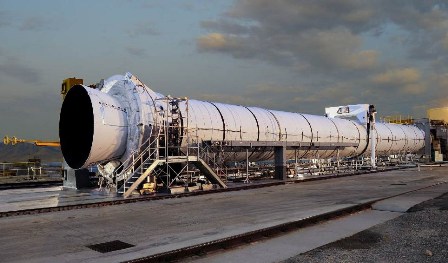

MEXICO: Everything is “GO” for a planned static test-firing of a five-segment solid rocket booster (SRB) in the salt flats of Utah. On March 10, NASA and Orbital ATK are planning on unsheathing “the most powerful” SRB from the support structure that currently surrounds it for the test which is slated to occur on the morning of the following day. If everything goes according to plan, it could mark the latest step in the space agency’s efforts to return to the business of sending crews to locations such as an asteroid – and possibly Mars.
Dubbed the “Qualification Motor 1”, or “QM-1”, the test will take place at Orbital ATK’s T-97 test stand located at Promontory, Utah, on March 11 at 9:30 a.m. MDT (1530 GMT). An estimated 103 objectives, measured on more than 534 instrumentation channels, have been laid out in front of the engineers who will be at the “hot motor” test.
The booster will be pre-heated to a temperature of some 90 degrees F (32 °C) prior to activation so as to determine how the booster behaves at a high temperature. The test will also work to ensure that the motor meets ballistic requirements.
Whereas some reports have work on the QM-1 beginning late last month, in actuality, preparations stretch back all the way to 2012 with original plans to conduct the test in 2014. However, a void was discovered in the solid fuel that powers each of the SRBs and Orbital ATK (at the time ATK) had opted to conduct a thorough review of the problem.
ATK Demonstration Motor 2 DM 2 static test fire NASA image posted on SpaceFlight Insider
To date, three test firings have been conducted for use on the former Ares V and current SLS launch systems. Photo Credit: NASA
“We thought we had an understanding as to why these voids were forming, but we wanted to take a closer look at them to gain a better understanding of the situation,” said Orbital ATK’s Kent Rominger during a Dec. 3, 2015, exclusive SpaceFlight Insider interview.
Orbital ATK’s engineers will monitor the test to gain additional insights into upgrades that have been made to the new insulation and propellant liner, as well as a redesigned nozzle which is being used on the booster.
Once fired, the SRB used on the QM-1, which is placed in the horizontal position during the test, will unleash an estimated 3.6 million pounds-force (22 million horsepower; 16 MN) at maximum thrust.

Tesla driverless system to use updated radar technology
WASHINGTON: Electric carmaker Tesla announced Sunday it was upgrading its Autopilot software to use more advanced radar technology. In a...