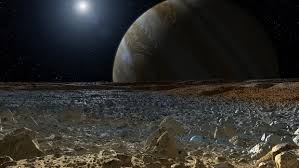

NEW YORK: New research into the mysterious rusty ‘scratches’ on the surface of Jupiter’s moon Europa could be evidence for subsurface salt water – whole oceans of it – and the possibility of life, a team from NASA’s Jet Propulsion Laboratory (JPL) in the US suggests.
By recreating exactly a patch of Europa’s surface in a lab, JPL scientists Kevin Hand and Robert Carlson were able to show that the presence of salt, exposed to radiation near the surface, could be the reason for the yellowish-brown colour seen within the youngest regions of the moon’s surface. “If it’s just salt from the ocean below, that would be a simple and elegant solution for what the dark, mysterious matter is,” Hand said in a press release.
Samples of common salt – or sodium chloride – along with mixtures of salt and water were tested in a special vacuum chamber simulating Europa’s chilly surface temperature of -173 degrees Celsius, then bombarded with an electron beam to simulate radiation. After hours of exposure, Hand and Carlson discovered a chemical fingerprint matching features on Europa’s surface and increasing the likelihood that the moon harbours a vast subsurface ocean of sea salt.

Tesla driverless system to use updated radar technology
WASHINGTON: Electric carmaker Tesla announced Sunday it was upgrading its Autopilot software to use more advanced radar technology. In a...