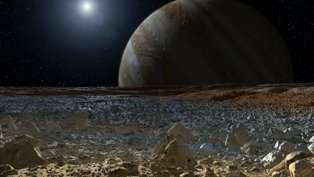

LONDON: NASA wants to go to Europa. No, it’s not in Europe. And for soccer fans, it has nothing to do with the Europa League.
Europa is one of Jupiter’s larger moons. It’s about the size of Earth’s moon, and it’s thought to be one of the best places to look for life in our solar system — besides Earth, of course.
Interest in the icy world heated up in 2012 when the Hubble Space Telescope observed water vapor above the south polar region of Europa. NASA says those observations gave scientists strong evidence of water plumes erupting off the moon’s surface.
Long before Hubble made those findings, a NASA spacecraft named Galileo traveled to Jupiter in 1995 and found evidence that Europa has a salty ocean beneath its frozen crust. NASA says that ocean may have more than twice as much water as Earth.
“Europa has tantalized us with its enigmatic icy surface and evidence of a vast ocean, following the amazing data from 11 flybys of the Galileo spacecraft over a decade ago and recent Hubble observations suggesting plumes of water shooting out from the moon,” John Grunsfeld, associate administrator for NASA’s Science Mission Directorate in Washington, said in a statement in May.
“We’re excited about the potential of this new mission and these instruments to unravel the mysteries of Europa in our quest to find evidence of life beyond Earth.”
NASA hopes the new probe will help determine if Europa really does have the ingredients for life, according to Barry Goldstein, manager of the Europa Project at NASA’s Jet Propulsion Laboratory in Pasadena, California.

Tesla driverless system to use updated radar technology
WASHINGTON: Electric carmaker Tesla announced Sunday it was upgrading its Autopilot software to use more advanced radar technology. In a...