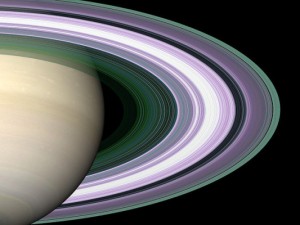
NEW YORK: Structures present on the rings can be the effect of many causes, but many times different moons of the 6th Planet from the Sun, Saturn, are the culprits. The dark gaps near the left edge of the A ring (which is the outermost broad ring) are caused by the two moons Pan and Daphnis who are embedded in the gaps.
In the case of the wider Cassini division, which is the dark area between the outer A ring and the inner B ring, it has its source from a resonance with the medium-sized moon Mimas that orbits well outside the rings. Prometheus can be noticed orbiting outside the A ring while the F ring can be seen vaguely to the left of Prometheus.


This view looks toward the sunlit side of the rings from about 15 degrees above the ringplane. The image was taken in red light with the Cassini spacecraft wide-angle camera on Jan. 8, 2015.
The view in the image looks towards the side of the rings which were exposed to sun’s light from about 15 degrees above the ring plane. The image was taken in red light with the wide angle camera of the Cassini spacecraft on 8th Jan, 2015. The obtained view was at a distance of almost 566,000 miles or 911,000 kilometers from the ringed planet and at a phase angle of 37 degrees. Image scales is at 34 miles or 54 kilometers per pixel.
The Cassini mission is a project co-operated by NASA, the European Space Agency and the Italian Space Agency. The Jet Propulsion Lab, which is a division of the California Institute of Technology in Pasadena, takes the task of managing the mission for Science Mission Directorate of NASA in Washington DC.
The Cassini orbiter and its two onboard cameras were designed, developed and assembled at JPL. The imaging operations center is based at the Space Science Institute in Boulder, Colo.