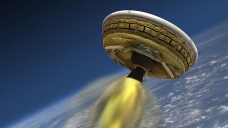


HONG KONG: NASA’s “flying saucer” is good to go for a test launch from Hawaii, but wave conditions in the Pacific Ocean aren’t so good for a splashdown and recovery. As a result, the scientists behind the saucer have twice had to postpone their tryout of technologies that could someday be used for landings on Mars — where there are no oceans to worry about.
The flying saucer is formally known as the Low-Density Supersonic Decelerator, or LDSD. The rocket-powered platform incorporates an inflatable, doughnut-shaped device called the Supersonic Inflatable Aerodynamic Decelerator, plus a parachute that’s meant to withstand supersonic wind speeds.
The LDSD had its first field test last June at the U.S. Navy’s Pacific Missile Range in Kauai, Hawaii. A helium balloon lofted the payload up to 120,000 feet, and then the rocket pushed the LDSD up another 60,000 feet — to a region of the stratosphere where the air is as thin as it is on Mars. The 20-foot-wide inflatable decelerator worked as expected, but as soon as the 110-foot-wide parachute opened, it was shredded apart.

Pakistan to get $3b loan from Islamic Trade Financing Corporation
ISLAMABAD: Islamic Trade Financing Corporation (ITFC) to provide Pakistan with a $3 billion loan, according to an official statement released...