FRANCE: Imagine the distinct possibility that among the billions of stars located in our vast Milky Way Galaxy, there might be a habitable zone where water probably exists and life as we know it as well.
Scientists have studied more than 150 exoplanetary systems with more than one planet circling the host star, thru the Kepler space telescope of NASA.
The new research, published in Monthly Notices of the Royal Astronomical Society, revealed the thousands of planets orbiting stars in our Milky Way galaxy. Researchers were able to compute that the stars in the Milky Way have one to three planets orbiting the habitable zone.
PhD student in the research group Astrophysics and Planetary Science at the Niels Bohr Institute at the University of Copenhagen, Steffen Kjær Jacobsen said, “In these 31 planetary systems located near the habitable zone, our calculations showed that there was an average of two planets in the habitable zone. According to statistics and the indications we have, a good share of the planets in the habitable zone will be solid planets where there might be liquid water and where life could exist.”
He added, “In 124 of the planetary systems, the Titius-Bode law fit with the position of the planets as good as or better than our own solar system. Using Titus-Bode’s law we tried to predict where there could be more planets further out in the planetary systems. But we only made calculations for planets where there is a good chance you can see them with the Kepler satellite,”
Researchers urged other scientist to look further into the records from the Kepler satellite again for more signs of the planetary systems they have predicted, as a number of them should be quite apparent.
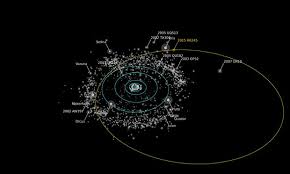
Astronomers discover distant dwarf planet beyond Neptune
LONDON: A dwarf planet half the size of Britain has been found tumbling through space in the most distant reaches...