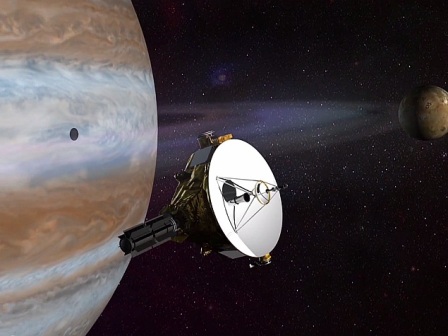
NEW YORK: New Horizons spacecraft of NASA has officially begun its six-month long approach towards Pluto and it has also started to record precious data about the dwarf planet and its surroundings.
The spacecraft is expected to approach Pluto around July 14th. The spacecraft, which was launched from Earth in January 2006, was in hibernation for large parts of its journey. It came out of its final hibernation on 6th December. So far it has covered 3 billion miles in its journey.


Alan Stern, New Horizons’ principal investigator from Southwest Research Institute, said, “We’ve completed the longest journey any craft has flown from Earth to reach its primary target, and we are ready to begin exploring.”
The spacecraft will start clicking images of Pluto, using its Long-Range Reconnaissance Imager, from 25th January. NASA believes that the pictures will play a crucial role in navigating the probe as it covers the remaining 135 million miles to the dwarf planet. It will also help mission scientists understand the dynamics of Pluto’s moons.
Mark Holdridge, the New Horizons’ encounter mission manager from Johns Hopkins University, said, “We need to refine our knowledge of where Pluto will be when New Horizons flies past it. The flyby timing also has to be exact, because the computer commands that will orient the spacecraft and point the science instruments are based on precisely knowing the time we pass Pluto which these images will help us determine.”
The probe on the spacecraft, which will study Pluto, its biggest moon Charon and the planet’s other moon, has seven instruments on it. The probe is carrying a compact multicolor camera, two powerful particle spectrometers, advance imaging infrared and ultraviolet spectrometers, a space-dust detector and a high resolution telescope.
The spacecraft also has the telecommunications equipment and flight computers amongst other systems, which are powered by a single radioisotope thermoelectric generator. It consumes less electricity than two 100-watt light bulbs.
That mission is expected to carry on till 2026. But the astronomers are hoping that the mission can be stretched till 2030, if the instruments on the spacecraft are able to last that long.