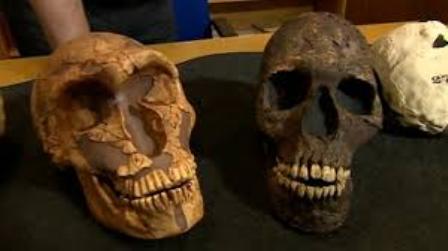

EUROPE: There is mounting evidence that modern humans had a big role to play in the decline and subsequent extinction of our direct ancestors, the Neanderthals. The latest research to suggest so comes from the University of Bologna in Ravenna. A team led by paleoanthropologist Stefano Benazzi focused on determining the moment when the first modern humans ventured into Europe before spreading across the continent, displacing the Neanderthals, who are believed to have died out between 41,000 and 39,000 years ago.
The scientists looked at two hominin teeth dated back 41,000 years and discovered at two sites in Italy thought to have been inhabited by Protoaurignacians, the race that came before the Aurignacians (the first humans in Europe). The Aurignacians are believed to have populated Europe between 35,000 and 45,000 years ago, but more precise dating had not been done until now.
The two fossilised teeth’s DNA was analysed, and then one of them was compared to a variety of other DNA: from 52 present-day people, ten early humans, ten Neanderthals, two Denisovans – another pre-human species – one representative of a hitherto unclassified pre-human species that lived in Spain, and even a chimpanzee. The Protoaurignacian DNA was found to be the same as the modern human samples, which proved that these early modern humans did indeed step on European soil shortly, in paleoanthropological terms, before the Neanderthals started declining.

Tesla driverless system to use updated radar technology
WASHINGTON: Electric carmaker Tesla announced Sunday it was upgrading its Autopilot software to use more advanced radar technology. In a...