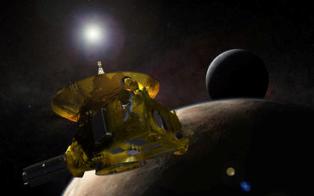

LONDON: The New Horizons spacecraft, racing toward the dwarf planet Pluto and its retinue of satellites, has survived a glitch and is ready to make its close approach on July 14. Normal science operations will resume on July 7, NASA reports.
New Horizons entered safe mode on July 4, but mission managers have determined that the vehicle did not experience a hardware failure. A timing flaw in the command sequence of the vehicle apparently occurred during preparations for the close approach.
“During that time the autonomous autopilot on board the spacecraft recognized a problem and — as it’s programmed to do in such a situation — switched from the main to the backup computer. The autopilot placed the spacecraft in ‘safe mode,’ and commanded the backup computer to reinitiate communication with Earth. New Horizons then began to transmit telemetry to help engineers diagnose the problem,” NASA reported on the day of the incident.
Mission engineers are not planning on carrying out that operation again for the remainder of the encounter with Pluto.
“I’m pleased that our mission team quickly identified the problem and assured the health of the spacecraft. Now — with Pluto in our sights — we’re on the verge of returning to normal operations and going for the gold,” said Jim Green, NASA’s Director of Planetary Science.
NASA officials have concluded that the data lost during the shutdown should have no effect on their primary mission, and little will be lost from secondary goals of the program.
“In terms of science, it won’t change an A-plus even into an A,” Alan Stern, New Horizons Principal Investigator at the Southwest Research Institute, told the press.
New Horizons is currently three billion miles from our home planet, a distance so great, it takes radio waves traveling at the speed of light 4.5 hours to reach the vehicle from Earth. All in all, it takes nine hours for a directive to be sent to the vehicle and have confirmation arrive back to controllers. This significant time delay adds additional challenges to engineers carrying out the historic approach.

Tesla driverless system to use updated radar technology
WASHINGTON: Electric carmaker Tesla announced Sunday it was upgrading its Autopilot software to use more advanced radar technology. In a...