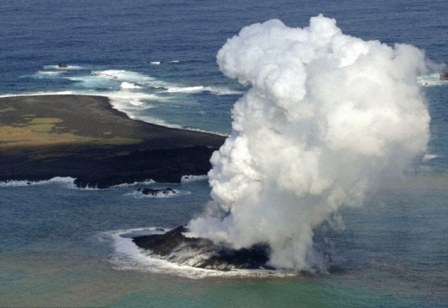
NEW ZEALAND: Underwater volcanoes are generally unobtrusive – but volcanic-ups may affect climate change, according to new research.
Previously, scientists presumed underwater volcanoes are Earth’s gentle giants, oozing lava at slow, steady rates, but the new study said they produce maybe eight times more lava annually than land volcanoes.


Due to the chemistry of their magmas, the carbon dioxide they emit is currently at about 88 million tonnes a year, the same as, or perhaps a little less than, from land volcanoes, said study author Maya Tolstoy of Columbia University’s Lamont-Doherty Earth Observatory in the US.
If underwater volcanoes were a little bit more active, their carbon dioxide output would shoot up, Tolstoy said.
The findings suggested that models of earth’s natural climate dynamics and human-influenced climate change may have to be adjusted.
“People have ignored seafloor volcanoes on the idea that their influence is small – but that’s because they are assumed to be in a steady state, which they’re not,” said Tolstoy.
“They respond to both very large forces, and to very small ones, and that tells us that we need to look at them much more closely.”
In the study, Tolstoy and colleagues closely monitored 10 submarine eruption sites using sensitive new seismic instruments.
They also created new high-resolution maps showing outlines of past lava flows and analyzed some 25 years of seismic data from ridges in the Pacific, Atlantic and Arctic oceans.
Sea levels drop as water gets locked into ice, relieving pressure on submarine volcanoes and causing them to erupt more.
Seismic data also suggested that undersea volcanoes pulse to life every two weeks. That is the schedule upon which combined gravity from the moon and sun cause ocean tides to reach their lowest points, thus, subtly relieving pressure on volcanoes below.
“This study… may have a long-term feedback into our whole climate system. If we are going to protect Earth we have to understand how the planet functions as a whole,” Tolstoy added.
The study was published in the US journal Geophysical Research Letters Friday.