

Customs Today
  • Home
  • Islamabad
  • Karachi
  • Lahore
  • National
  • Transfers and Postings
  • Chambers & Associations
  • Business
No Result
View All Result
Customs Today
  • Home
  • Islamabad
  • Karachi
  • Lahore
  • National
  • Transfers and Postings
  • Chambers & Associations
  • Business
No Result
View All Result
Customs Today
No Result
View All Result
Home Science & Technology Science

New technology may make interplanetary travel on electromagnetic propulsion

byCustoms Today Report
04/05/2015
in Science, Science & Technology
Share on FacebookShare on Twitter

You might also like

Tesla driverless system to use updated radar technology

12/09/2016

Apple to develop its own self-driving technology

10/09/2016

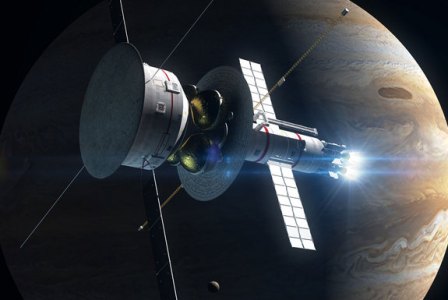
NEW YORK: One of the biggest hurdles to interplanetary space travel has always been fuel: how can you possibly carry enough to get you to the outer reaches of the solar system? Well, the fuel-conscious scientists at NASA may have cause to celebrate. Their colleagues at the Johnson Space Center recently tested an electromagnetic (EM) propulsion drive, which could replace traditional propellant during space travel. Although EM Drives have been tested in the past, the folks at Johnson were the first to conduct such trials under similar conditions found in space-in a vacuum.
It was long-believed that EM Drives worked great in theory, but could not overcome certain fundamental principles of physics to be applied in the real world. That all changed last summer when a team of advanced propulsion researchers from NASA EagleWorks, led by Harold “Sonny” White, presented their findings at a conference in Cleveland, Ohio. And the key to their success lay in the Quantum Vacuum.
The practical application of EM Drives to spaceflight (and more specifically, space stations) was brought one step closer to reality in 2010 by Professor Juan Yang in China, whose research showed that such drives may provide the necessary power to enable the International Space Station to function without the need for energy re-boosts from visiting vehicles. The only problem was overcoming the complex physics of propulsion in space. That’s where White’s team stepped in.

Tags: international space stationNew TechnologyQuantum Vacuum

Related Stories

Tesla driverless system to use updated radar technology

byCT Report
12/09/2016

WASHINGTON: Electric carmaker Tesla announced Sunday it was upgrading its Autopilot software to use more advanced radar technology. In a...


Apple to develop its own self-driving technology

byCT Report
10/09/2016

SAN FRANCISCO: Apple may not become an automaker, but it still wants to develop its own self-driving technology. The iPhone-maker's...

NASA spots slowest known magnetar

byCT Report
10/09/2016

WASHINGTON: Astronomers have found evidence of a magnetar - magnetised neutron star - that spins much slower than the slowest...

‘YouTubers’ outshining old-school television

byCT Report
09/08/2016

SAN FRANCISCO: A media revolution is taking place, and most people over 35 years of age aren’t tuned in. Millennial...

Next Post

China stocks surge at end of trade, CSI300 advances climbs 7.2pc

  • Terms and Conditions
  • Disclaimer

© 2011 Customs Today -World's first newspaper on customs. Customs Today.

No Result
View All Result
  • Transfers and Postings
  • Latest News
  • Karachi
  • Islamabad
  • Lahore
  • National
  • Chambers & Associations
  • Business
  • About Us

© 2011 Customs Today -World's first newspaper on customs. Customs Today.