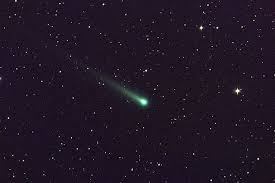

WASHINGTON: It is recently discovered by Australian amateur astronomer that comet is closer to Earth than it has ever been. The comet — known officially as Comet Lovejoy (C/2014 Q2) — is an icy remnant from the primordial solar system; it is now nearing its closest approach to Earth on Wednesday night when it will pass only about 43.6 million miles away.
Currently, Comet Lovejoy is drifting into our evening sky. In fact, you can find it low in the southeastern sky during late evenings this week. On the night of Dec. 28, the comet passed by the globular star cluster known as M79 in the constellation of Lepus.
Your best bet will be to observe from a dark, un-light-polluted site such as the mountains or other rural areas. That’ll be tough as we enter the first week of 2015, since the moon will become very bright in our sky. But during the second week, the moon will vanish from the evening sky and you can again begin your search. Perhaps by then, the comet will be bright enough to spot with the unaided eye from a dark sky.
Just how bright it becomes, however, is anyone’s guess. Comets are notoriously fickle; they can flare up at any time, or they can fade and go totally unnoticed by the average stargazer. As noted comet-hunter David Levy likes to say: “Comets are like cats. They both have tails and they both do what they want.” Their unpredictable and ghostly nature has led people over the ages — even some today — to interpret them as cosmic harbingers of doom.

Tesla driverless system to use updated radar technology
WASHINGTON: Electric carmaker Tesla announced Sunday it was upgrading its Autopilot software to use more advanced radar technology. In a...