ABUJA: An oil tanker came trundling down the highway one recent morning here, but customs officers were in on a secret: It was full of rice.
So they ambushed it, scoring yet another victory for the law on one of Africa’s busiest chicken-and rice-smuggling routes.
Since May, guards manning this gateway to Africa’s largest economy have belatedly begun enforcing a decade-old government directive that chicken and rice — the most popular pairing in Nigerian cuisine — should be made with only locally farmed ingredients.
It is one of many ways civil servants have stepped up their game since March, when the country elected Gen Muhammadu Buhari, a former dictator, as its new president.
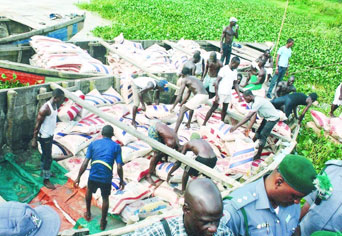
Until then, cheap imported chicken and rice sacks had poured across this border from Benin on the back of motorcycles, taxis, trucks, canoes, bicycles, wheelbarrows and in buckets atop women’s heads.
Traffickers say they typically paid off customs officers in cash, or sometimes food. Then Mr Buhari took office.
Now, agents aren’t letting chicken get to the other side.” Every day, they chase us like thieves,” said Germain Kodja, who pilots his motor scooter several times a day into Nigeria with cartons of frozen poultry stacked between his knees.
Recently, he tripled his fee after officers caught him, slapped him, seized his chicken and burned it, he said.
“It’s not like before,” he said. This is what Nigerians are calling the “Buhari effect.” In his return to office, the president has sworn to hunt down corrupt officials, from cabinet ministers to lowly civil servants.
Nigerians who remember Mr Buhari’s stint as dictator in the 1980s take him at his word: His army jailed hundreds of bureaucrats for graft back then.
More than 200,000 were fired or forced into retirement in 1984 alone. These days, the general’s portrait hangs above nearly every government lobby, and civil servants are trying to at least appear busy.
On Nigerian roads, cops direct traffic in the hot sun.
Bus drivers are ordered to park in tidy lines.
Business leaders delight in how few bribes they are paying. Agents patrolling Nigeria’s frontier with Benin worry Mr Buhari has informers watching them, said Selchang Taupyen, public relations officer for the Seme border customs unit.” Everybody is on his toes,” said Mr Taupyen, whose unit calls its crackdown on poultry and rice smuggling Operation Hawk Descend.
“Nobody can remove smuggling, we know that.…But we have suppressed it.” The clampdown spurs hope that one of the world’s most corrupt countries can change.
For two decades, Nigeria has consistently ranked among the bottom third of Transparency International’s clean governance rankings.
Only 20 countries are harder places to do business, according to the World Bank. It is currently easier to move goods in and out of Syria than Nigeria, according to the World Bank’s 2015 Doing Business rankings.
Shouting matches with bribe-seeking officials at Nigeria’s ports and airports have become standard practice. But in recent months, officers have been out on patrol for the first time in recent memory, prowling the swamps along the border.
They have tipped over canoes caught navigating the creeks with their rice in their bellies, complain smugglers who have watched their fortunes sink.
Agents have lifted up the back seats of taxis to discover sacks of rice under false bottoms.
In front of television news crews, they have burned 6,668 10kg cartons of frozen assorted poultry parts. Smugglers say they are operating at a loss.
Countless boxes of frozen chicken have melted in the sun.
Some traffickers have lodged complaints with Nigerian customs about the refusal to take bribes.” We’ve begun to speak to them,” said Adetokuno Akseyin, whose taxi trunk was full of poultry.
Eventually, he suspects, they will reach an informal agreement, he said: “Every household has to eat.” For decades, corruption was a part of the job at this border, where a rope in the mud marks the beginning of Nigeria.
Promotions depended on extorting bribes, and delivering them up the command chain, said Caleb Omoyiola, a customs assistant comptroller general before he retired in 2008. That is changing.
“Better, better, every day,” said Mr Omoyiola, who now advises small businesses looking to import.
“It’s the Buhari effect we are having now.”
He commands that aura of respect.
“We pray it lasts.” Not everyone is sure it will.
There is a lot of money in getting Nigerians their chicken and rice. Nigeria’s farmers can’t begin to feed their 184 million compatriots.
So in the early 2000s, the government banned imports of chicken and rice, to encourage locals to build paddies and hen houses. Instead, those bans made the chicken-smuggling business fly.
Just 20% of the chicken Nigerians eat comes from Nigeria, according to the Poultry Association of Nigeria.
The rest sneaks over the border. That has made people on both sides rich.
To feed Nigeria, tiny Benin imported almost as much rice as China last year, according to the World Trade Organisation, which ranks Benin the world’s fourth-biggest buyer of foreign rice.
The country of 11-million imports almost as much whole frozen chicken as the UK.
At least 85% of that slipped into Nigeria, the US Department of Agriculture said. “You can’t stop this,” said David Ayo, a smuggler who dispatches carloads of chicken into Nigeria.
“What’s happening in Nigeria is what? Their favourite cuisine is what? Chicken and rice.”

Singapore, Nigeria trade volume hits N846b
SINGAPORE: The trade volume between Nigeria and Singapore reached N846bn from 2011 to 2015, while the absolute balance of trade...