A new report has described African ports especially those in West Africa as the least efficient globally. However, the report explained that trade volume is on the increase despite the challenges.
According to the report, how to best serve the region is a daily dilemma for shipping lines, adding that CMA CGM subsidiary recently announced an “emergency port congestion” surcharge for Doula, Cameroon to be implemented on May 1, 2015.

“Despite modest gains reported in the first three months of 2015, overall reliability to and from the (African) continent is still far from optimal,” said the co-author of the study, Victor Shieh.
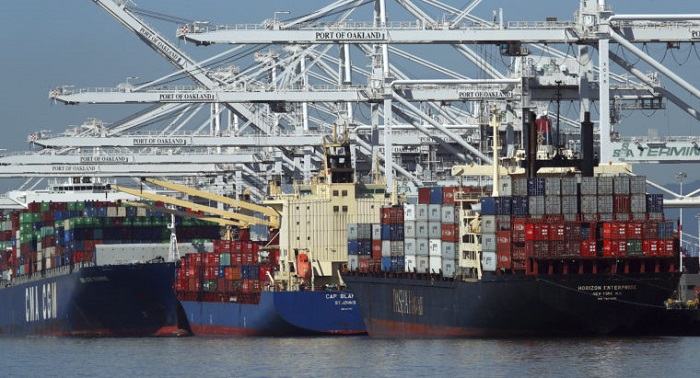
Shieh noted that with container shipping lines deploying much bigger ships on services from Asia, quay and landside congestion at African ports is a massive challenge for the industry.
The report explained that even the planned new terminals at Abidjan, Tema, Lome and Lagos, “which are forecast to add up to 12 million Twenty foot Equivalent Units (TEU) of quayside capacity, will only improve reliability if there is land-based infrastructure growth as well”.
According to the London Loadstar, West Africa’s ports are almost entirely dependent on roads to remove containers, “so it follows that the bigger the ships, the more severely landside congestion will affect nearby cities”.
It explained that vessels of 5,000 TEU or more account for more than 20 per cent of tonnage deployed between Asia and West Africa, and “MSC has even introduced an 8,500-TEU ship on its Africa Express Service that hubs at Lome, Togo”.
For the year 2014, the Nigerian Ports Authority (NPA) recorded a cargo throughput of 86,603,903 metric tonnes of cargo, an increase of 12.64%.6 per cent over the 2013 figure of 76,886,997 metric tonnes.
Reacting to the result, recently, Managing Director of NPA, Habib Abdullahi said within the year, management continued to pay attention to first and foremost improving existing port infrastructure in the areas of rehabilitation of port quay walls and apron, deepening of channels, upgrading of common user facilities and wreck removal from channels.