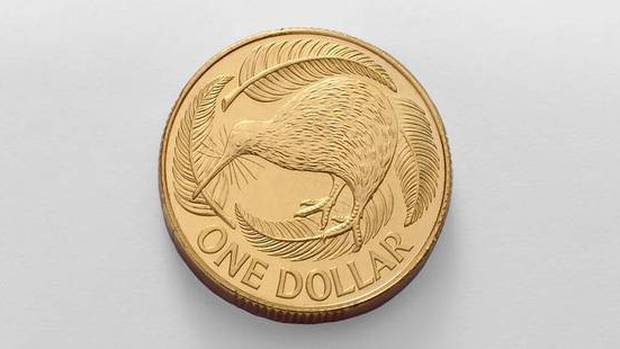
The New Zealand dollar drifted lower with slightly weaker Chinese economic data offering few new leads and investors unwilling to make big bets amid mixed views on local consumer price.
The kiwi was trading at 67.23 US cents at 5pm from 67.59 cents this morning and 67.61 cents here last week. The trade-weighted index was at 72.93 from 73.30 and 73.18 here late Friday.


Data today showed annual growth in China’s economy slowed to 6.4 per cent in the fourth quarter, as expected, consistent with recent data signalling a slowdown in the economy of New Zealand’s biggest trading partner.
Mixed local and international economic data, and the potential for new bank capital requirements to trim growth here, have investors more focused on the outlook for rate cuts.
Brokerage OFX says investors’ near-term focus will be on Wednesday’s December quarter CPI data.
While analysts expect headline inflation to fall short of the central bank’s 2 per cent midpoint, “a soft read may prompt the RBNZ to consider a move away from neutral and bring forward a rate cut in a bid to stimulate activity and price pressures in an otherwise stagnant economic environment,” OFX said in a client note today.
Westpac is picking a 0.1 per cent lift for the quarter, leaving the annual measure at 1.9 per cent, largely due to lower fuel prices in December.
‘In contrast, we think underlying inflation will be stronger than the RBNZ’s forecast, reflecting the tightening labour market and the lower New Zealand dollar,” the bank said in a weekly commentary.
Despite that, it’s not expecting a rate hike before November 2020, in-part due to a softening in growth from the central bank’s proposed increase in bank capital requirements.
ASB, which is picking a 0.5 per cent increase in non-tradable inflation for the quarter, expects the central bank’s estimate of annual core inflation to come in at 1.7 per cent.
“We expect the RBNZ to leave the OCR on hold until at least August 2020,” the bank said in a note Friday.
The local dollar fell 1.3 per cent against the US dollar last week as positive signs on the US-China trade front trumped mixed economic data both there and in New Zealand.
US equities had a strong finish on Friday after the US Federal Reserve reported a stronger-than-expected 1.1 per cent jump in December manufacturing activity – the biggest gain since February. Consistent with the mixed outlook, the University of Michigan reported a 7.7 per cent drop in consumer sentiment – the steepest drop in more than three years. The university attributed the drop to the partial government shutdown, tariff tensions, unstable financial markets and the slowing global economy.
The kiwi dollar was recently at 52.27 British pence from 52.37 pence this morning and 52.12 pence here Friday. It was at 59.09 euro cents from 59.22 cents this morning and 59.32 last week.
The weaker performance coincided with UK Prime Minister Theresa May reportedly considering rewriting the 1998 Good Friday Agreement with Ireland as part of her plan to devise a new Brexit deal acceptable to all factions in parliament, the Daily Telegraph reported.
Adding new text to the agreement to ensure there is no hard border on the island after the UK leaves the European Union in March may be a way of avoiding having to commit to the unpopular backstop, which Brexiteers believe risks tying the UK to EU laws indefinitely. Government and senior EU officials are sceptical the re-write would work, the Telegraph said.
The kiwi fell to 93.79 Australian cents from 94.01 cents last week. It was at 73.69 Japanese yen from 73.19 last week, and at 4.5619 Chinese yuan from 4.5820.
The New Zealand two-year swap rate fell 2 basis points to 1.87 per cent; the 10-year swap rate rose 0.5 basis points to 2.60 per cent.