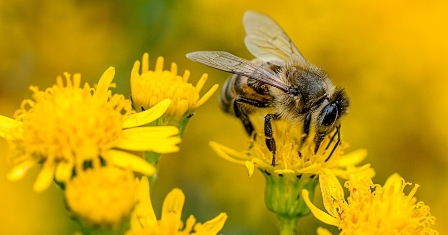

WASHINGTON: A new Cornell study of New York state apple orchards finds that pesticides harm wild bees, and fungicides labeled “safe for bees” also indirectly may threaten native pollinators.
The research, published June 3 in Proceedings of the Royal Society B, finds the negative effects of pesticides on wild bees lessens in proportion to the amount of natural areas near orchards.
Thirty-five percent of global food production benefits from insect pollinators, and U.S. farmers have relied exclusively on European honeybees, whose populations have been in decline for decades due to colony collapse disorder.
“Because production of our most nutritious foods, including many fruits, vegetables and even oils, rely on animal pollination, there is an intimate tie between pollinator and human well-being,” said Mia Park, an assistant professor at the University of North Dakota and the paper’s first author, who worked on the study as a Cornell entomology graduate student. Co-authors include professor Bryan Danforth and associate professor John Losey, both in entomology.
“With honeybee numbers in decline, relying on wild pollinators and encouraging the services they provide seem very important,” Park said.
The researchers studied 19 New York state apple orchards over two years, 2011 and 2012. They determined the health of bee populations by analyzing the numbers of wild bees and honeybees and the number of species for each orchard. They also created an index of pesticide use from low to high use, then quantified the amount of natural areas that surrounded each orchard.

Tesla driverless system to use updated radar technology
WASHINGTON: Electric carmaker Tesla announced Sunday it was upgrading its Autopilot software to use more advanced radar technology. In a...