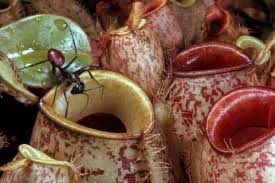
PARIS: A new study from a team led by Dr Ulrike Bauer of Bristol’s School of Biological Sciences published in the Proceedings of the Royal Society B, suggests that the plants use an elaborate strategy to maximize the number of ants that they catch.
Borneo’s Nepenthes bicalcarata, better known as pitcher plants, share an interesting relationship with their prey. The ants that they tend to catch and digest, Camponotus schmitzi, are better known as diving ants, swimming ants, and pitcher-plant ants. In other words, what they are best known for is being eaten by pitcher plants.


“The plant’s key trapping surface is extremely slippery when wet but not when dry. For up to eight hours during dry days, these traps are ‘switched off’ and do not capture any of their insect visitors. At first sight, this is puzzling because natural selection should favour traps that catch as many insects as possible,” said Dr Bauer in a statement.
Surveys of the plants in their historic habitat in Borneo suggests that the plants, rather than capturing one ant at a time, sporadically capture large batches of the ‘pitcher plant ants’. The researchers conducted tests in which they kept the trapping surface of the plants wet all the time. They found that the plants became unsuccessful at trapping large batches of the ants.
“Ants are social insects. Individual ‘scout’ ants search the surroundings of the nest for profitable food sources. When they find a pitcher trap full of sweet nectar, they go back to the colony and recruit many more ant workers. However, a trap that is super-slippery all the time will capture most of these scout ants and cut off its own prey supply,” said Dr Bauer.
So, the when the scouts didn’t return to the nest the rest of the colony did not follow and the total number of ants captured by the plants actually went down.