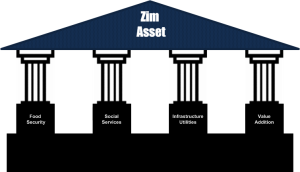
HARARE: Zimbabwe’s enduring power supply crisis has effectively wrecked the country’s economic revival strategies under the Zimbabwe Agenda for Sustainable Socio-Economic Transformation (Zim-Asset).
Electricity was expected to be one of the key drivers of Zim-Asset, a blueprint that envisages increased access to electricity by domestic consumers, both within urban and rural communities. All Zim-Asset’s projections and expectations of seeing existing power generation plants refurbished to boost internal power generation by 300MW by the end of this year have been proved wild.


The reduction in water allocation for power generation at Kariba Dam and continued machine breakdowns at coal-fed Hwange, Bulawayo, Munyati and Harare thermal power stations, against peak demand for electricity for winter cropping, has resulted in intense load shedding throughout the country.
Mining, one of the most crucial industries in the country that Zim-Asset hoped would be another prop for the ailing southern African economy, has been plagued by tumbling production levels, safety fears and closures due to power outages.
Consequently, the outages have resulted in some mining concerns losing about 10 percent of their production time.
“The mining industry continues to battle with reliability of electricity supply,” said Chamber of Mines of Zimbabwe chief economist, David Matyanga.
“Power outages arising from faults and demand management-related load shedding affected supply in the first quarter of the year and some mines lost as much as 10 percent of their production time. Outages in the morning shift are particularly damaging because they affect drilling and blasting operations. Such outages affect the generation of ore to feed milling plants which impacts daily output,” Matyanga said.
Massive load-shedding has affected both electricity consumers and the country’s prospects of turning the corner through Zim-Asset, in a big way.
It has also been noted that due to load shedding, students are unable to study at night, while electricity shortages have also triggered gridlock in hospitals when intensive care nurses were said to have been forced to ventilate patients manually.
The other problem that Zimbabwe has faced for many years is energy efficiency. The country has vast amounts of coal in the west but, by the time it would be converted into electricity and passed over to the eastern cities, a significant amount is lost in transmission.
Zimbabwe has been experiencing crippling power shortages, with national demand at peak periods estimated at 2 200MW, against available generation of about 1 000MW. The country has been importing from regional power utilities to cover the shortfall, but this has also not been enough to meet demand.
Imports are currently only coming from Mozambique’s Hydro Cahora Bassa, which has been supplying a paltry 50MW but on a non-firm contract. What this means is that Hydro Cahora Bassa has been supplying Zimbabwe only when it has enough to do so.
Although the short-term picture looks bleak for Zimbabwe, plans are in place to make sure the country does not find itself in an embarrassing position.
In February, Energy Minister Samuel Undenge said the power shortages would end in 2018. His prognosis was based on the finalisation of several power projects that are in the pipeline.