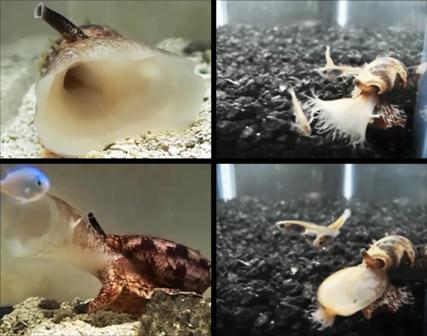
LONDON: The new research has uncovered one highly unusual ingredient in the cone snail’s venom cocktail – weaponised insulin.
The geographic cone snail (conus geographus) uses the chemical to cause a plunge in blood sugar, leaving the fish sluggish and unable to swim to safety.In this way the snail is able to entrap whole schools of small fish.


Geographus is one of the most venomous creatures on Earth, and known to have killed dozens of people in accidental encounters.It hunts in two ways, both by releasing toxins into the water and by firing a harpoon-like poison-tipped tooth into its prey.No antidote exists for a cone snail sting, which contains a mixture of nerve agents.
In tests, a synthetic version of the hormone – made from shorter protein chains than normal insulin – lowered the blood sugar levels of adult zebrafish. Injected into water, it also reduced the movements of fish larvae.
US scientist Professor Baldomero Olivera, from the University of Utah, said: ‘This is a unique type of insulin. It is shorter than any insulin that has been described in any animal.’We found it in the venom in large amounts.’
The insulin forms part of a poison mixture evocatively known as ‘nirvana cabal’.
Adding the hormone to its armoury of toxins allows the snail to disable entire schools of swimming fish by sending them into hypoglycaemic shock – a condition brought on by plummeting blood sugar levels.
The type of insulin, while stripped down, matches that found in fish, the scientists learned.
A second cone snail species that practised fish-netting, Conus tulipa, was also found to have insulin in its venom.
Other species that only operate as ambush hunters did not possess the insulin toxin, and nor did others that prey on molluscs or worms.